Adjectives do not have a plural or singular form: they always stay the same.
Only adjectives used as determiners have plural forms. They are the:
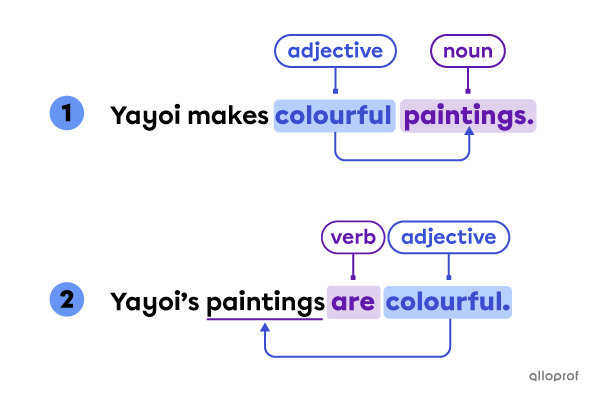
In some cases adjectives can be placed after a noun or a pronoun.
|
In fixed expressions like: |
With indefinite pronouns: |
For poetic/dramatic effect: |
|
president elect |
something great |
colours unrefined |
|
attorney general |
nothing new |
precision attainable |
|
court martial |
anyone skilled |
result outstanding |
|
words unspoken |
nowhere specific |
difficulties inconceivable |
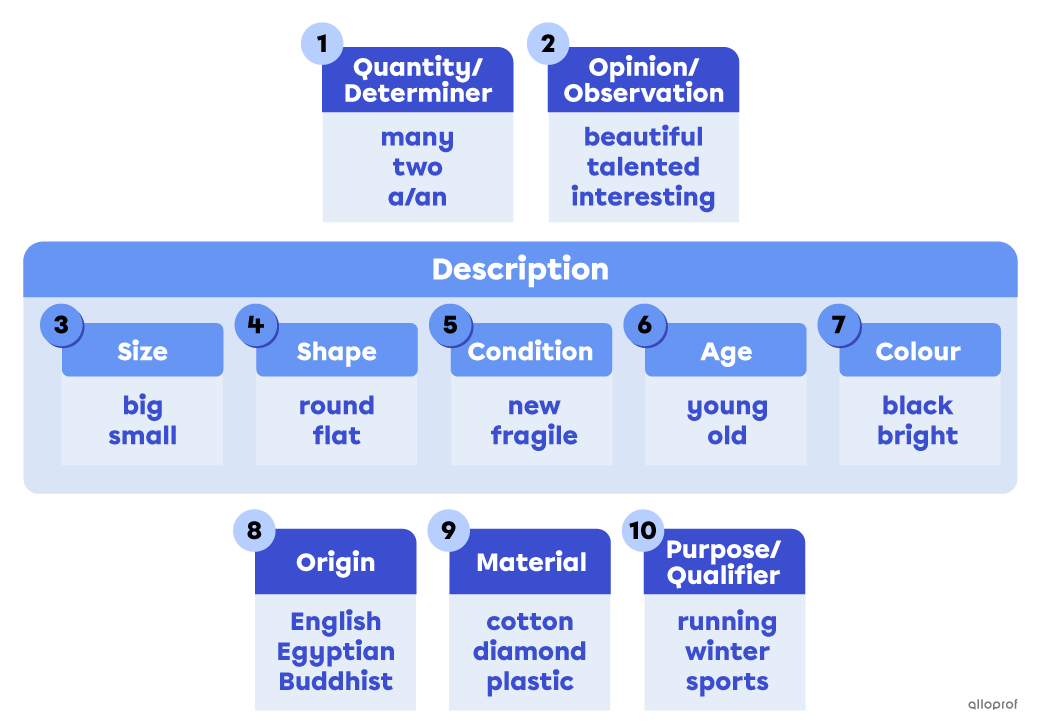
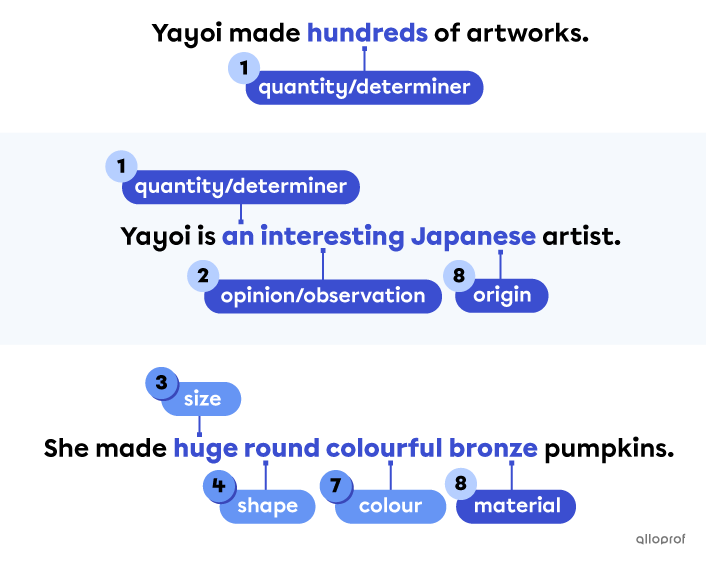
Some adjectives get overused.
Here are some alternatives:
Another way to say…
|
nice |
good |
bad |
great |
best |
more |
|
kind |
excellent |
awful |
exceptional |
first |
additional |
|
small |
big |
easy |
difficult |
cool |
funny |
|
little |
huge |
simple |
tough |
relaxed |
amusing |
|
happy |
sad |
angry |
new |
young |
old |
|
glad |
unhappy |
mad |
recent |
blooming |
aged |
Comparative and superlative adjectives are used to compare things or people.
Comparative adjectives compare two things or people.
For example comparing two people’s age:
|
Person 1 |
Age comparison |
Person 2 |
|
Yayoi is |
older than |
Ushio. |
Superlative adjectives compare more than two things or people.
For example comparing one person’s age to several other people’s ages:
|
Person 1 |
Age comparison |
All other people |
|
Yayoi is |
the oldest |
artist in the group. |
Visit the Comparative & Superlative Adjectives concept sheet to learn more about them.
Possessive adjectives are used to indicate ownership of a noun, who it belongs to.
The possessive adjectives are:
|
my |
|
your |
|
his |
|
our |
|
your |
|
their |
Visit the Possessive Adjectives concept sheet to learn more about them.
Demonstrative adjectives are used to:
-
point something out
-
indicate the position of an object
-
indicate singular and plural
The demonstrative adjectives are:
|
this |
|
that |
|
these |
|
those |
Visit the Demonstrative Adjectives concept sheet to learn more about them.
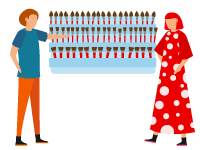
Interrogative adjectives are used to modify a noun in information questions.
|
Interrogative Adjective |
Used to ask about: |
Example |
|
|
What |
|
Question |
 |
|
Possible answer: |
|||
|
Which |
|
Question: |
 |
|
Possible Answer: |
|||
|
Whose |
|
Question: |
 |
|
Possible answer: |
|||
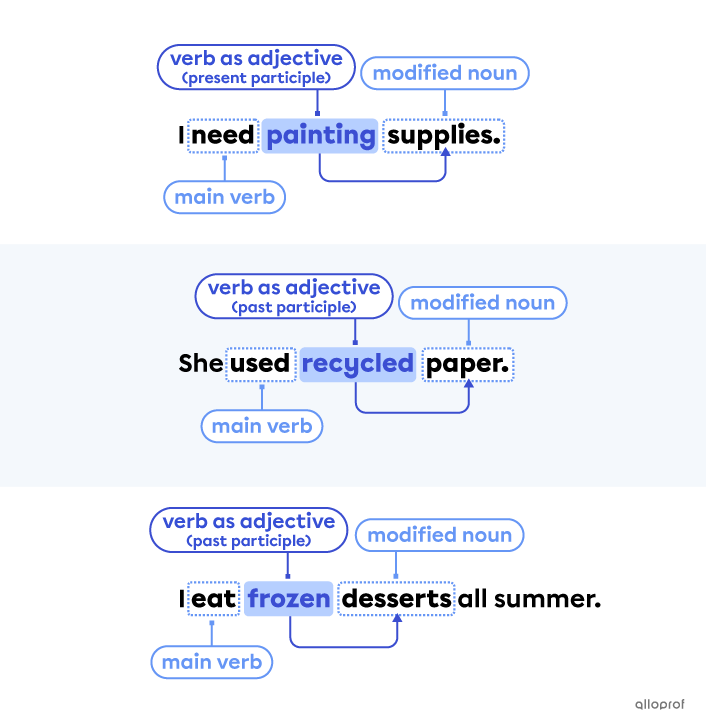
Verbs in the participle form can be used to modify or describe nouns. In these situations, they act just like adjectives.
The verb acting as an adjective is always placed before the noun it modifies or describes.
A proper adjective is the specific name used for a person, a place or a thing. Proper adjectives are based on proper nouns and also take capital letters.
|
Example: |
From the proper noun: |
Indicates: |
|
Yayoi is a Japanese artist.  |
Japan |
Nationality: She is from Japan. |
|
We’re using a Canadian recipe.  |
Canada |
Country of origin: it is from Canada. |
|
They bought a Victorian house.  |
Victoria |
From the time period when Queen Victoria reigned. |
|
He has Herculean strength.  |
Hercules |
It required great effort and strength. A reference to Hercules in Greek mythology. |
Compound adjectives are a combination of 2 or more words used to describe or modify the same noun.
| Hyphens (-) in compound adjectives: | Examples: | |
| placed before a noun | ✔ | It is a long-term plan. |
| placed after a noun | X | The plan is long term. |
| formed with an adverb ending in -ly | X | It was an expertly planned project. |
| Formation | Examples | |
 | last-minute large-scale short-hair | There are always last-minute preparations. I love large-scale sculptures. She likes short-hair brushes better. |
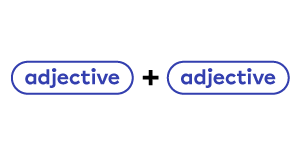 | white-hot top-right blue-grey | Be careful: The lamp is white-hot. The paper is on the top-right shelf. He took my blue-grey marker. |
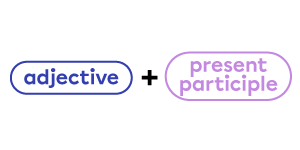 | good-looking fast-drying soft-shimmering | What a good-looking portrait! Yayoi chose a fast-drying paint. It gives it a soft-shimmering effect. |
 | old-fashioned best-known long-awaited | Ushio uses old-fashioned canvases. He is best-known for his abstract works. I can’t wait to see his long-awaited show. |
 | never-ending hard-working rather-interesting | Skill improvement is a never-ending journey. They are hard-working students. Some of them have rather-interesting ideas. |
 | almost-completed much-needed well-known | I have a few almost-completed pieces. After the show, I’ll take a much-needed vacation. Maybe I’ll become a well-known artist. |
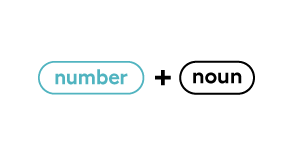 | five-star two-month thousand-word | We went to a five-star restaurant. There was a two-month wait before getting a table. I wrote a thousand-word review. |
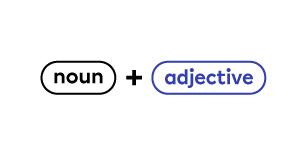 | world-famous jet-black brand-new | They met a world-famous painter. I was surprised by his jet-black moustache. He was also wearing brand-new sunglasses. |
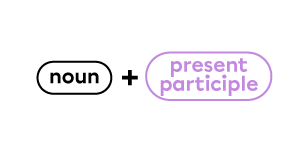 | ground-breaking time-consuming Japanese-speaking | The installation uses ground-breaking technology. Building it was a time-consuming process. Hopefully, there was a Japanese-speaking technician to translate the instructions for us. |
 | water-soaked hand-made creativity-oriented | She tried the water-soaked paper method. The hand-made paper worked well. She loves creativity-oriented experiments. |
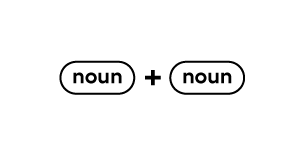 | part-time cotton-candy cookie-cutter | I have a part-time job in a t-shirt printing shop. We used a lot of cotton-candy pink dye. It isn’t a cookie-cutter production: everything is handmade. |
Compound adjectives using an adverb ending in -ly do not take a hyphen.
| Forms | Examples: | |
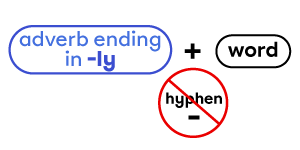 | completely new expertly built highly entertaining | Yayoi has a completely new studio. It is an expertly built workshop. She said it is a highly entertaining place. |
Yayoi, the character used in the examples, was inspired by the Japanese artist Yayoi Kusama. To learn more about her colourful life and work, visit the Yayoi Kusama Museum website.