
It’s better to prevent your child from dropping out of school than to have to manage the consequences. There’s no way to know what the future holds, but by fostering certain qualities in your child, such as self-esteem and intellectual curiosity, you can increase the likelihood of them staying in school.
Self-esteem is a person’s sense of their own worth. It develops over the course of a lifetime. Nurturing a child’s self-esteem from an early age, however, can reduce the risk of them dropping out of school. The greater their self-worth, the more personal satisfaction they’ll get from school-related achievements, and the more inclined they’ll be to set and work toward academic goals.
When a child has high self-esteem, they’re able to judge their performance and notice improvements without getting hung up on how their peers are doing in comparison. As a parent, you can reinforce your child’s belief in their abilities by praising their strengths and encouraging them to show off their natural talents. Here are a few tips to get you started:
- Enrol your child in extracurricular activities
Extracurricular activities provide the opportunity to develop new skills and forge new friendships, two key building blocks for self-esteem.
- Acknowledge their efforts
Instead of putting the emphasis on grades, focus on your child’s efforts and progress. For example, if your child gets only 50 percent on a math test, see the glass half full: praise them for improving since their last test or for studying hard and managing to answer every question.
- Be supportive of their interests
Does your child have a passion or a favourite hobby (e.g., art, hockey, gymnastics)? Listen when they talk about their interests and encourage them however you can, such as by borrowing relevant books from the library. Gestures like these show your child you care.
- Help them build self-awareness
Self-awareness is one of the pillars of self-esteem. If your child understands their interests, strengths, and weaknesses, they’ll be less likely to underestimate themselves. To help develop that awareness, try asking them to name their strengths, their fears, their greatest wish, their favourite subject, etc.
- Highlight their achievements
Being able to acknowledge personal achievements is just as important as owning up to mistakes. It’s often easier to complain about things that don’t go right, but your child should learn to take pride in their successes—without, of course, putting anyone else down. You can teach by example by pointing out when they deserve to give themselves a pat on the back.
Curiosity is what drives a person to always want to learn more. Whereas some are born with a thirst for knowledge, others need a bit of a nudge. To stimulate your child’s intellectual curiosity, encourage them to ask questions about the world around them. Don’t worry about not having all the answers—that’s a good thing! It’s the perfect excuse for teaming up with your child to do some research.
Here are a few more ideas on how to whet your child’s appetite for knowledge:
- Make sure they have access to books
Providing your child with easy access to a wide variety of books will encourage them to explore their interests and feed their desire to learn. Not sure where to start? Alloprof has book suggestions for the following age groups:
- 6 to 8 years
- 9 to 11 years
- 12 to 17 years
- Go to the theatre
You can usually find theatre productions for kids of all ages. Going to see a play with your child is a great opportunity to bond and discover new topics for discussion.
- Check out activities at local museums
Many museums host free family activities on weekends. From craft classes to writing workshops, they always provide an enriching experience.
The strategies above are meant to set up success factors. They’re not magic formulas, and they won’t guarantee that your child won’t drop out of school. But when you put them all together, they can help students stay on track.
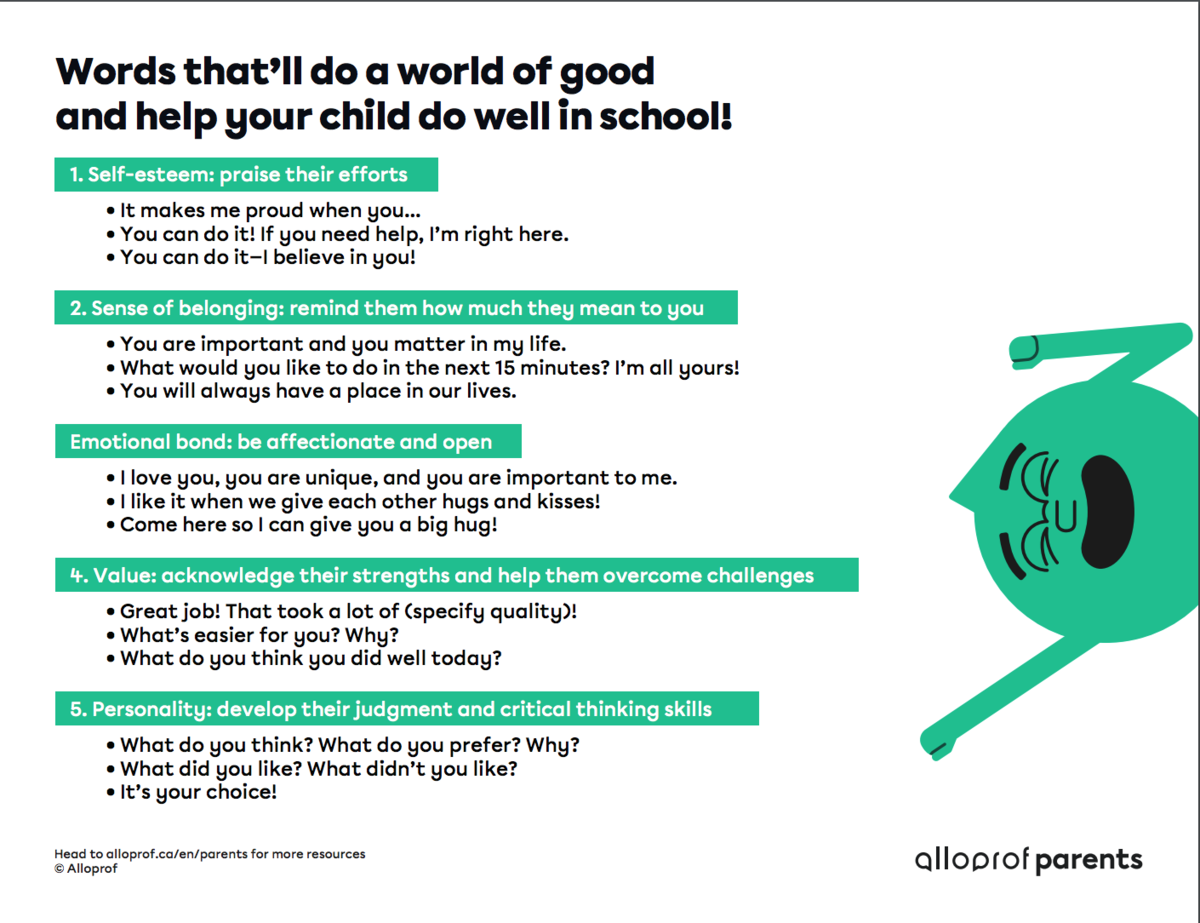
Did you know? Using positive language is another way to help increase your child’s self-esteem. For example, you can tell your child that you’re proud of them, that you believe in them, and that you know they’ll reach their goals. For more inspiration, download our document on this topic: “Words That’ll Do a World of Good.”.
Writing : Viviane Asselin
Scientific review : Marie-Michèle Bourassa, psychoeducator
***
Rewriting : The Alloprof Parents' team
MADIOT, Pierre. Enseignants, parents, réussite des élèves : quel partenariat ? France, CRDP de l’académie d’Amiens Crap-Cahiers pédagogiques, Collection Repères pour agir, 2010.