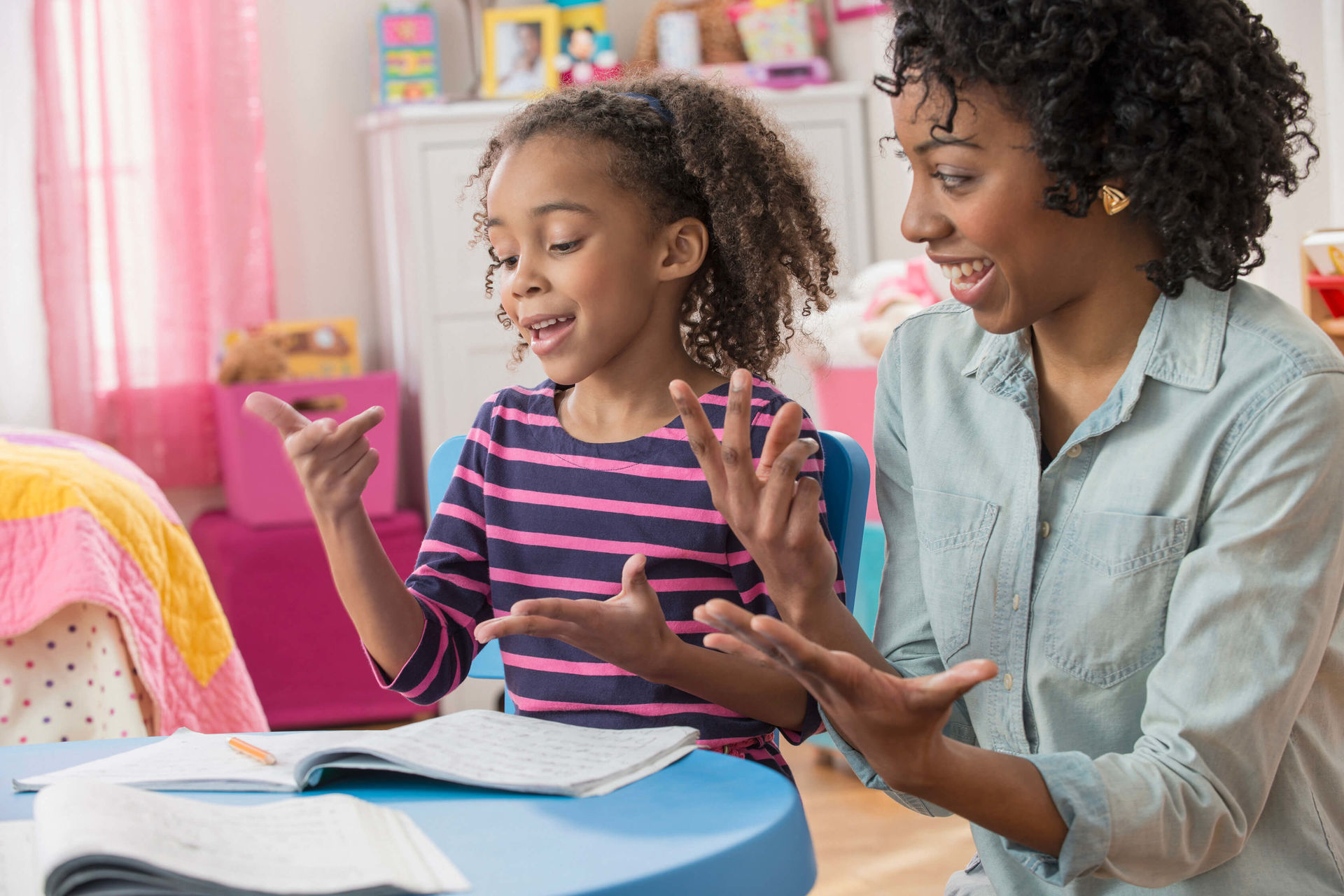

Mental math is essential to getting the hang of numbers. It is a skill your child will use for the rest of their life to count, measure, estimate, and compare quantities. Whereas young children often learn to count by heart without really thinking about it, practising mental math helps kids become familiar with numbers and mathematical operations in a more concrete way. Here are five fun mental math activities to try with your child.
An easy way to help your child practise mental math is to give them fun estimation challenges. Simply ask them to guess how many objects are in front of them without counting them one by one. Other family members or your child’s friends can also take part to add an element of competition. If you want, you can give a small prize to whoever comes closest to the correct answer. You can play this game with all kinds of objects:
- A container of marbles or candy
- A bowl of popcorn
- Pens in a pencil case
- A box of paper clips
- A handful of pebbles or beans
- A book or stack of books (estimate the number of pages)
- A pile of coins (estimate their total value)
- Etc.
To take this activity a step further, ask your child what strategies they use to come up with their guesses. Ultimately, this game is not about getting the answer right every time; how your child gets to their answer is more important than speed or accuracy. For example, they might use referents (the size of familiar objects that serve as points of comparison), such as the width of their pinky or the length of their hand.
Later on, you can make the game more difficult:
- Take 10–20 objects (utensils, small toys, etc.) and tell your child how many there are. Give them a moment to study the objects before asking them to close their eyes. Then, add or remove an object or two. Have your child open their eyes again and estimate how many objects there are. Repeat the exercise until they are able to do this quickly.
On a whiteboard or scraps of paper, write out riddles that involve finding different ways to arrive at the same number. This activity will test your child’s knowledge of different mathematical operations. For example, the number 7 can be calculated by adding 4 and 3, 5 and 2, 6 and 1, etc. To increase the difficulty, give your child one minute to find as many ways as possible to arrive at a number using addition, subtraction, multiplication, and division.
Here are a few sample riddles:
- Find five ways to get the number 10 using these numbers: 13, 29, 51, 5, 3, 10, 9, 1, 2, 40. Each number can be used only once.
- Find as many ways as you can to get the number 100 using these numbers: 25, 20, 50, 3, 4, 70, 10, 2. Each number can be used only once.
- Find as many ways as you can to get the number 200 using these numbers: 50, 8, 2,000, 100, 400, 4, 25, 10, 150, 2. Each number can be used only once.
You can also use play money and ask your child to pay you an amount. They will have to do a bit of mental math to figure out how to get the exact amount with the money they have. Allomarket is a great resource to use when playing grocery store with your child.
Skip counting is a technique that lets you count more efficiently. Your child can practise skip counting in either ascending order (from smallest to largest) or descending order (from largest to smallest, like a countdown) using this grid of numbers from 0 to 101. Try asking them to do the following:
- Skip count by 2 and colour the counted numbers red
- Skip count by 5 and colour the counted numbers blue
- Skip count by 10 and colour the counted numbers yellow
- Circle the numbers that have more than one colour
- Etc.
It may help to use a number line (a line divided into equal parts with numbers in ascending order) and have your child imagine a frog or grasshopper that leaps in intervals of 2, 5, 10, 100, and so on.
You can even turn skip counting into a physical activity! On a paved surface, draw a number line in chalk and have your child jump between the numbers, whether in ascending (addition) or descending (subtraction) order.
Our math bingo activity turns mental math into child’s play! You can be the caller and read out equations while your child looks for the answers on their bingo card. When they find an answer, have them mark it with a token (like a button or pebble) or stamp. Once they have marked five numbers in a row (vertically, horizontally, or diagonally) or filled their whole card, they win and get to shout BINGO!
Kids love card and dice games, and they can be a terrific way to practise mental math. Here are a few examples:
- Each player rolls a die as many times as they like. The numbers they roll get added to their point total. If they roll a 1, they lose all their points and start again from 0. The game ends when a player reaches exactly 25 points. If a player goes over 25 points, they can choose to keep their points and pass the die to the next player.
- You can increase the difficulty of the previous game by using two dice. In this case, if the player rolls two 1s, they lose all their points and start again from 0. The game ends when a player reaches exactly 50 points.
- Deal a well-shuffled deck of cards into two equal piles. One player flips over the top card in both piles. The first player to correctly multiply the card values together wins both cards. The game ends when there are no cards left in either pile. The player with the most cards wins.
Alloprof has a couple of online games that involve mental math. With Fin Lapin and Météormath, which both feature several difficulty levels, your child can practise math operations while having a blast!
Writing : The Alloprof Parents' team