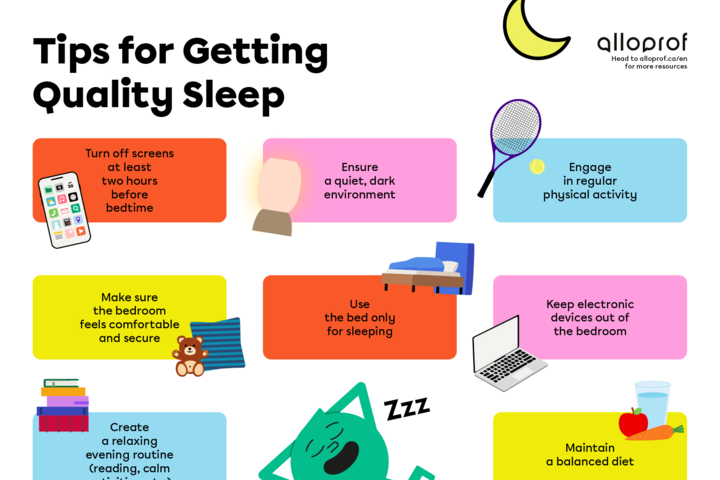
Sleep is essential for the growth and development of children and teens. It can also have a major impact on their academic success. See our poster for helpful tips for getting a good night’s sleep!
Getting enough sleep means sleeping long enough each night for your body and brain to fully recharge. The amount of sleep needed varies from person to person. In general, babies and children need significantly more sleep than adults.
Here are the recommended hours of sleep by age.[1]
| Age | Recommended Hours of Sleep |
|---|---|
| 3–5 years | 10–13 hours |
| 6–13 years | 9–11 hours |
| 14–17 years | 8–10 hours |
Nearly 40% of teenagers experience sleep problems: mainly difficulty falling asleep or staying awake for part of the night.[2]
Because the circadian cycle (the body’s internal clock) shifts to later hours during puberty, teenagers tend to fall asleep and wake up later. This doesn’t always line up with their daily schedule.
Environment and daily habits have a major impact on the quality of sleep. Supporting children with a healthy sleep environment and regular routines can improve their sleep quality. Here are some tips for improving sleep.
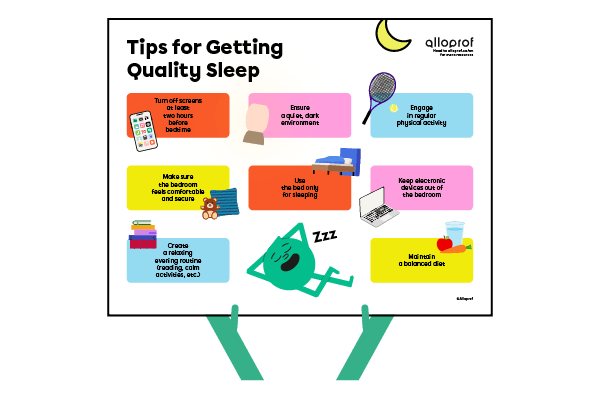
If you’ve tried these tips and your child still has trouble falling asleep or sleeping through the night, talk to a health care professional or a sleep specialist.
Children who don’t get enough sleep tend to be more tired and less focused. This makes learning and schoolwork more difficult.
Getting enough quality sleep helps them stay focused and engaged, supporting their academic success.
Here are some ways that sleep quality can affect your child’s learning.
| Concentration | Sleeping well helps students concentrate and makes it easier to:
|
|---|---|
| Memory | A brain is a bit like a computer, in that it needs to perform regular “updates.” During sleep, it sorts, organizes, and stores the information learned during the day. Its tasks include:
|
| Skills | New motor and cognitive skills are consolidated during sleep—which means it’s best to avoid late nights. Getting enough sleep helps your child:
|
| Behaviour | Lacking sleep can make children and teens agitated, irritable, and impulsive, which can affect their behaviour. Getting quality sleep helps your child:
|
- Gruber, Reut. ”Sleep and children: the science behind it.” The Douglas Research Centre. URL
- CHU de Québec. “Sommeil chez l’adolescent.” Université Laval. (French only) URL
- Lacombe, Marie Lise. “Hygiène du sommeil du jeune de 12 à 17 ans.” CHU Sainte-Justine. 2021. (French only) URL
- Lord, Catherine, et al. “Le sommeil des adolescents, pierre angulaire de leur santé mentale.” Ordre des psychologues du Québec. 2022. (French only) URL
- Réseau Morphée. “Le sommeil de 0 à 18 ans.” URL (French only)