In the early 1960s, Canada’s immigration policy shifted to a focus on applicants’ professional training, and the country started accepting more immigrants from non-Western countries. The Quebec government created the Quebec Ministry of Immigration in 1968, an action linked to Quebec nationalism in the context of the Quiet Revolution.
Immigration is when a person settles in a foreign country (host country) temporarily or permanently.
During the early 1960s, the Canadian government allowed more immigrants from non-Western countries to move to Canada. Immigrants were generally selected based on their job training to fill labour needs.
The term western means that which is to the west. The term Western countries refers to the countries of America, Europe and Australia.
Quebec wanted more autonomy to make decisions regarding immigration, so the province created its own department in 1968, later named the Ministry of Immigration.
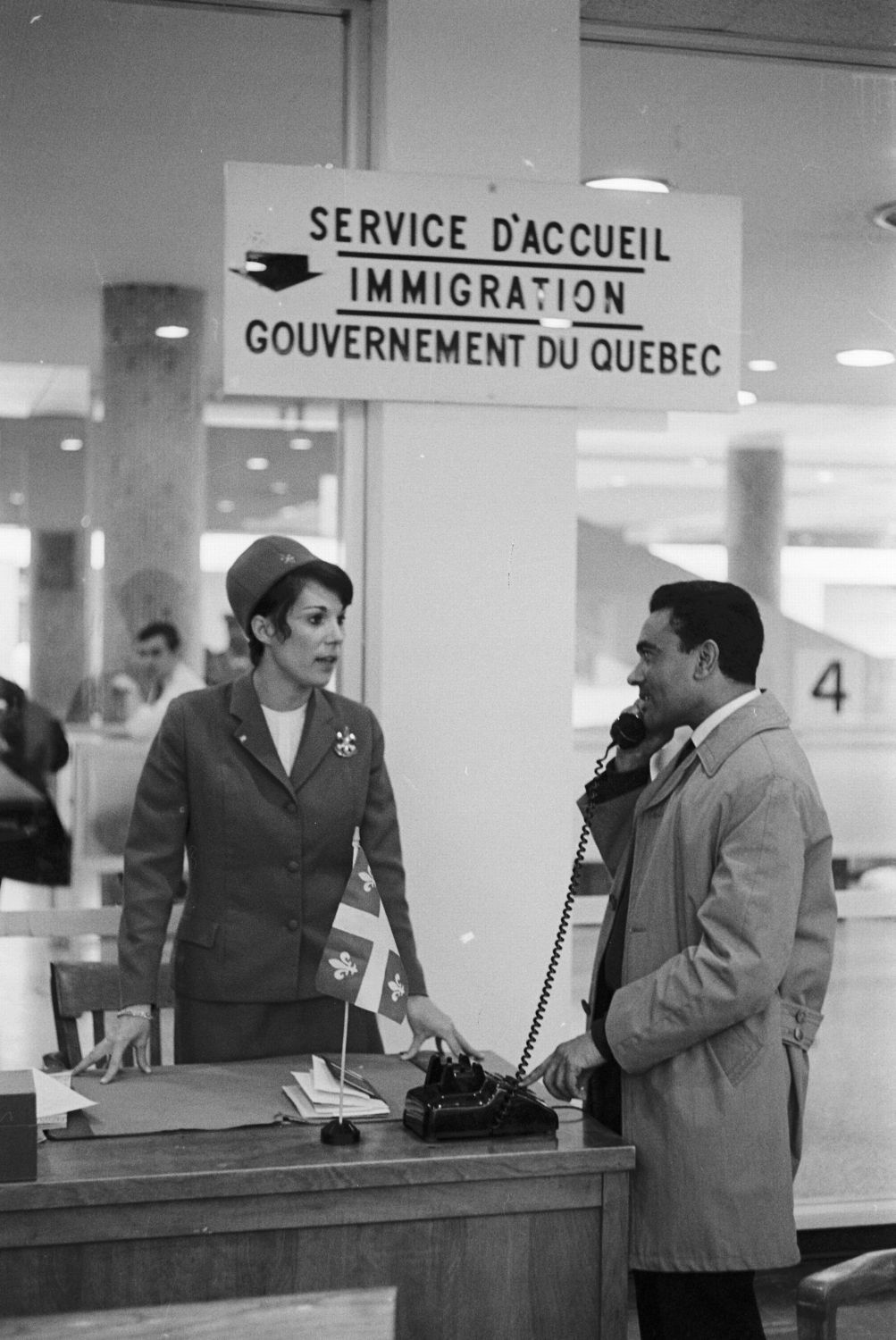
Source: Bureau de l’immigration à Dorval [Photograph], Szilasi, G., 1970, Bibliothèque et Archives nationales du Québec, (URL). CC BY-NC-ND[1]
In 1976, Pierre Elliott Trudeau passed the Immigration Act, which widened the eligibility criteria for immigrants to Canada.
Two years later, the Quebec government, led by René Lévesque, demanded more authority over immigration, namely with regards to French-language requirements. After signing an agreement with Ottawa, the Cullen-Couture agreement, Quebec was granted more freedom to decide how many immigrants to accept and the acceptance criteria.
The increase in immigration to Quebec, particularly starting in the 1970s, significantly transformed the province’s socio-cultural landscape. More and more people from Asia, Africa, and South America settled here. Most newcomers choose to settle in the Montreal area, enhancing the city’s multicultural character. At the same time, the government made significant francization efforts in order to ensure a common Francophone culture.
The growing diversity in Quebec at the time can be explained in part by the large number of refugees who were fleeing war and dictatorship in their home countries.
Multiculturalism outlines how different cultures within society coexist.
A refugee is a person who has been forced to leave their home country to escape a natural disaster, war or persecution that threatens their life and safety.
The 1976 Immigration Act expanded immigration eligibility criteria and facilitated the arrival of refugees.
In the years that followed, Quebec welcomed thousands of people fleeing war or dictatorship. Many people from Haiti and Vietnam sought refuge in Quebec, looking to escape the dictatorship of Jean-Claude Duvalier or the Vietnam War and its consequences.
These newcomers added to the diversity of Quebec’s cultural communities.
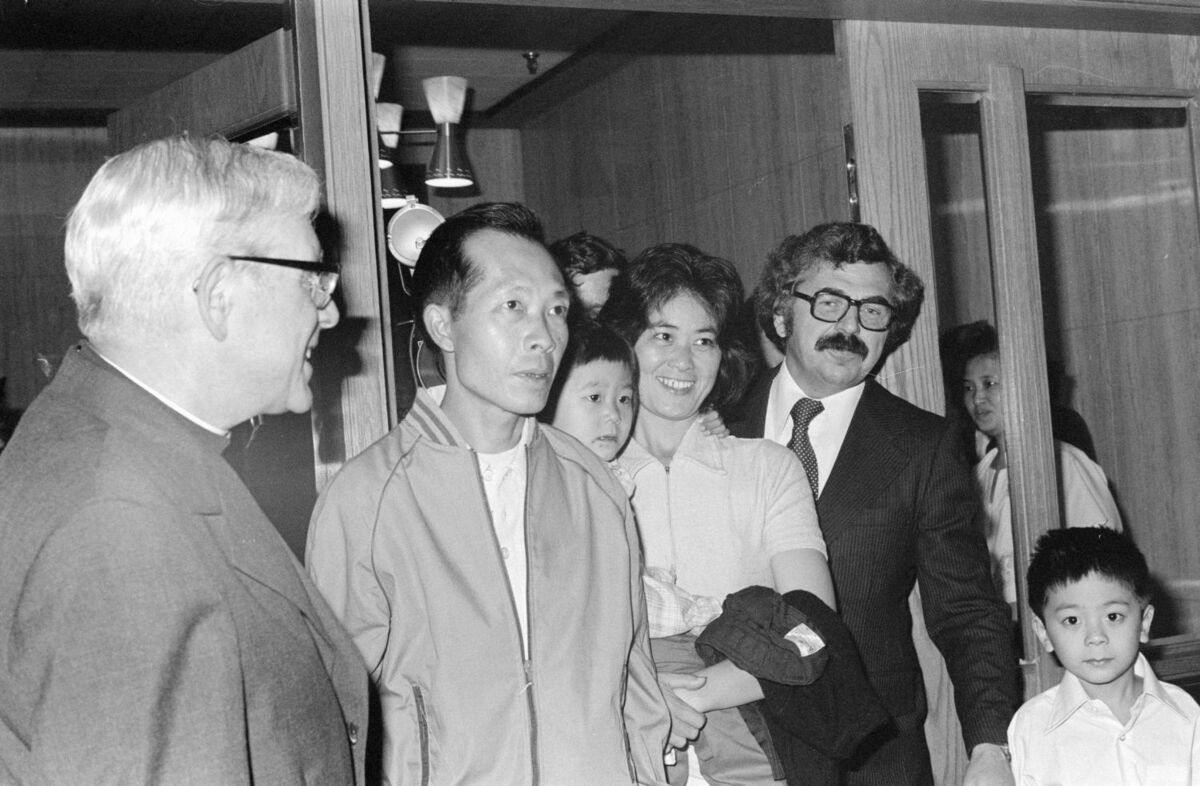
A sponsorship program was set up by the René Lévesque government in 1979 to help Vietnamese people looking to immigrate to Quebec.
Source: Rencontre du ministre Jacques Couture et de monseigneur Grégoire en compagnie d’une famille vietnamienne parrainée réunis au grand salon de l’Évêché de Montréal [Photograph], Rémillard, H., 1979, Bibliothèque et Archives nationales du Québec, (URL). CC BY-NC-ND[2]
- Szilasi, G. (1970). Bureau de l’immigration à Dorval [Photograph]. Bibliothèque et Archives nationales du Québec. (URL). CC BY-NC-ND
- Rémillard, H. (1979). Rencontre du ministre Jacques Couture et de monseigneur Grégoire en compagnie d’une famille vietnamienne parrainée réunis au grand salon de l’Évêché de Montréal [Photograph]. Bibliothèque et Archives nationales du Québec. (URL). CC BY-NC-ND