Developmental language disorder (DLD) is an invisible but very real condition that affects around 7.5 % of children in Quebec[1]. In this article, we deconstruct the myths associated with DLD, explore this disorder’s concrete impact on daily life, and find out why it is so little known. It’s the first step to better understanding and supporting children living with DLD.
DLD, formerly known as dysphasia, is a persistent neurodevelopmental disorder that affects both language expression and comprehension without the cause being related to a disability or other condition. Its symptoms can vary from mild to severe. DLD affects different aspects of language.
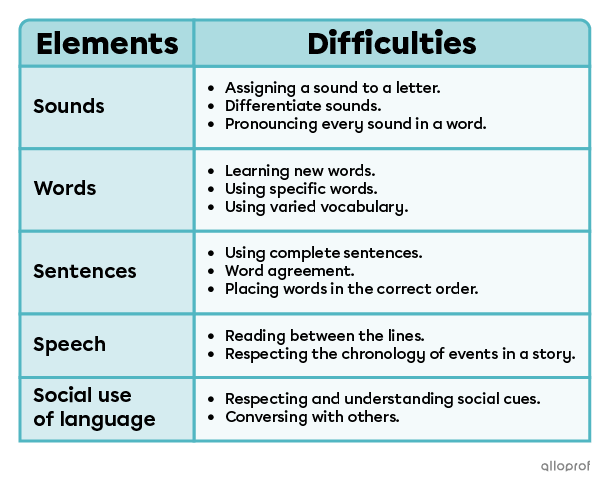
Data source: Regroupement TDL Québec. (n.d.). Trouble développemental du langage. (URL)
But this disorder affects much more than just language. DLD impacts a person’s personal life, social life, school life, mental health, and even career path.
- 1 in 14 children lives with a DLD.
- Of 4 people living with a DLD, 3 are boys.
- Children with a DLD are 3 times more likely to experience learning difficulties.
Data source: Regroupement TDL Québec. (n.d.). Le TDL en chiffre. (URL)
DLD doesn’t always occur in isolation. It is often accompanied by other disorders, known as comorbidities. Here are just a few examples.
- Attention deficit disorder with or without hyperactivity (ADHD): A child may have difficulty maintaining focus, staying organized, and regulating their impulsivity.
- Developmental coordination disorder (DCD): Formerly known as motor dyspraxia, DCD affects a person’s motor coordination, making writing and other motor tasks more difficult.
- Speech sound disorder: previously known as verbal dyspraxia, speech sound disorder affects the production of sounds, making speech less fluid and comprehensible.
A number of myths persist around DLD, which can hinder understanding of the disorder and support for the children affected by it. Here are some common misconceptions.
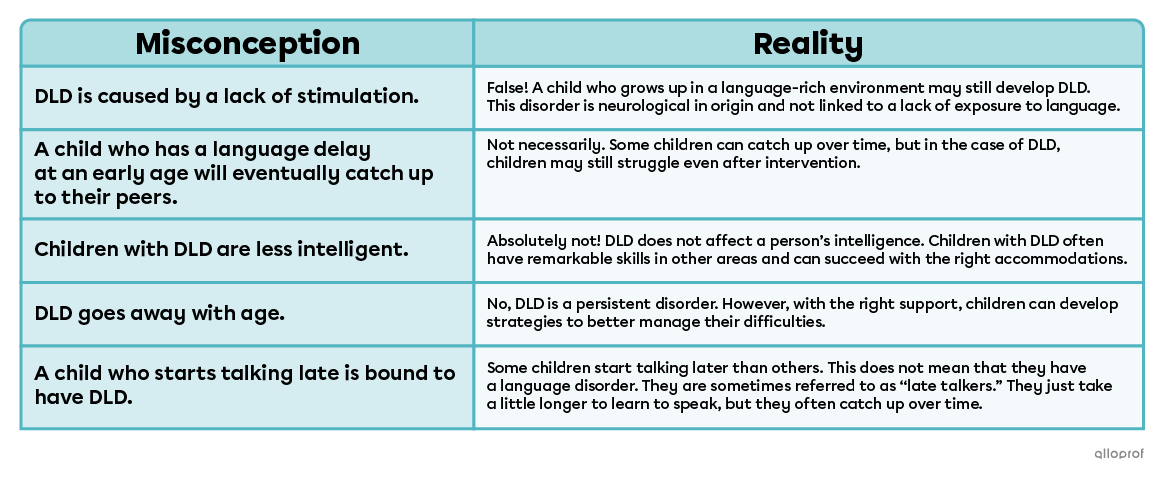
It’s sometimes hard to understand why a child with language difficulties also struggles with learning. DLD can affect a person’s ability to organize their ideas, memorize instructions, or understand abstract concepts. Even with speech therapy, children may have persistent challenges, which can be frustrating for them and those around them.
It’s important to understand that this diagnosis has changed names multiple times over the years. These frequent name changes mean that the disorder is less well known and understood. Today, thanks to scientific advances, we have a better understanding of the disorder, enabling us to provide more effective support for children impacted by it.
Although 7.5 % of the population (around 650,000 people in Quebec) is affected by DLD, this disorder remains little-known to the general public. There are several reasons for this[1].
- Lack of awareness: In contrast to other disorders such as ADHD or dyslexia, DLD receives less media attention and is infrequently addressed in educational training.
- Frequent changes in terminology: Previously known as dysphasia, then renamed DLD, this disorder has undergone several name changes, complicating its recognition and identification.
- Difficulty in making a diagnosis: The manifestations of DLD are varied and may be confused with other disorders, sometimes delaying its management.
- A lack of specialized resources: The number of professionals specializing in speech therapy or neuropsychology is limited, which can make access to diagnosis and intervention more difficult.
It’s essential to continue informing and raising awareness among parents, teachers, and caregivers in order to improve recognition and understanding of DLD. The more we talk about it, the better we can help children like Anthony to succeed.
This article was written in partnership with TDL Lanaudière, an organization that supports people with developmental language disorder (DLD), as well as their families, loved ones, and caregivers.
Consult the Regroupement TDL Québec to find organizations in your area.
- Regroupement TDL Québec. (n.d.). Le TDL en chiffre. (URL)
TDL Lanaudière, (n.d.). Qu’est-ce que le Trouble développemental du langage?. (URL)
Regroupement TDL Québec. (n.d.). Le TDL en chiffre. (URL)
Regroupement TDL Québec. (n.d.). Trouble développemental du langage. (URL)
Regroupement TDL Québec. (2023, October 18). Le trouble développemental du langage (TDL) et le lien avec la santé mentale [video]. Youtube. https://www.youtube.com/watch?v=VmHTS7Ovco0&t=42s
Regroupement TDL Québec. (2023, October 18). Définition du trouble développemental du langage (TDL) [video]. https://www.youtube.com/watch?v=KkZfoFGQe-Q
Regroupement Langage Québec. (2020). Le trouble développemental du langage, portrait du TDL. (URL).
Gauthier, G. and Tessier, M-A. (2023). Le Trouble Développemental du Langage (dysphasie) – la boîte à outils. Éditions de Mortagne.