This concept sheet explains what personal data is, how it’s collected, and why.
Your information belongs to you! We give you tools to learn how to protect it.
- Personal data is any information that can be used to identify an individual.
- Sensitive data is personal information that could bring harm to the person in question if it is revealed.
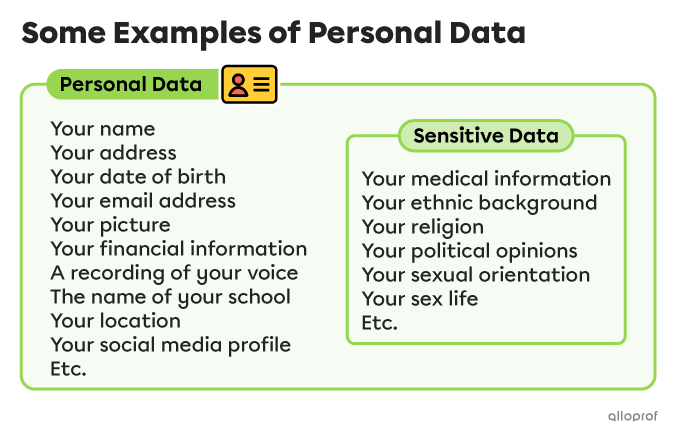
You probably share personal data every day. For example, when you shop online, you may be asked for your name, address, and bank details. When you’re on social media, you might share photos of yourself, your list of friends, or your location.
You might also be sharing data without realizing it. When you use the internet, cookies collect information like your location, IP address, and browser history.
Here are some other examples of times when your personal data may be collected.
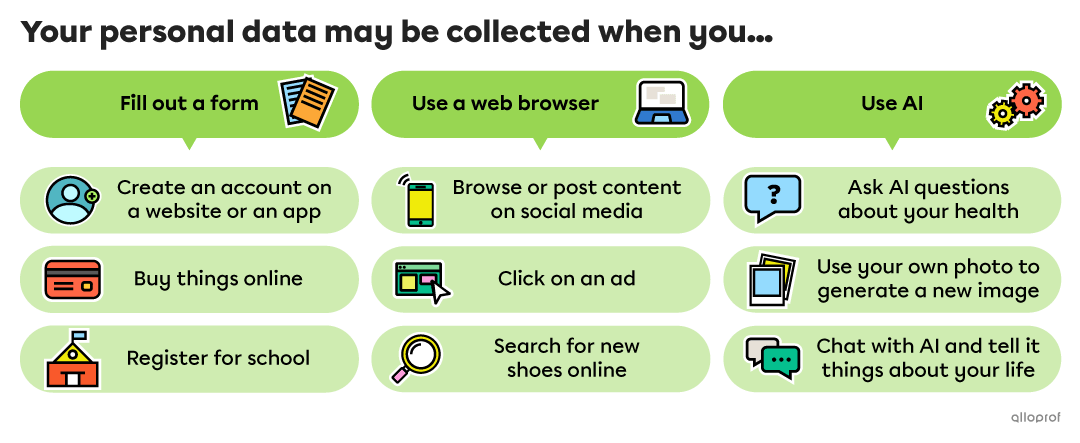
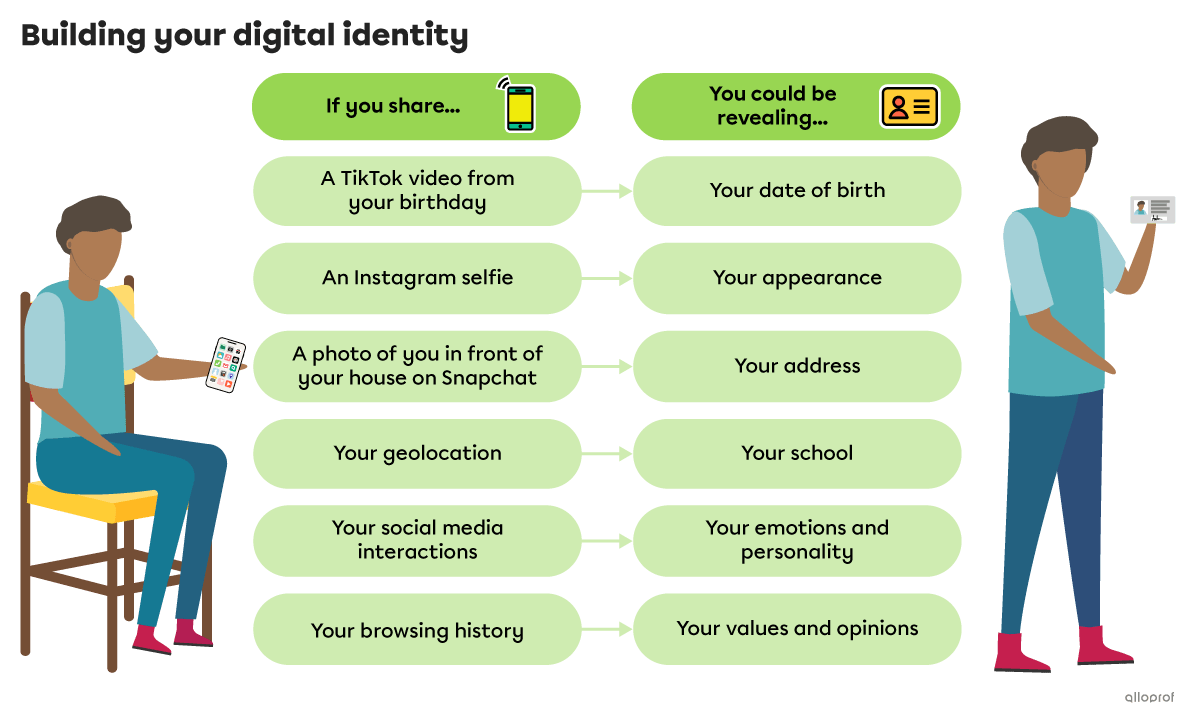
It may not seem like much, but when you put all that information together, it can create a fairly comprehensive picture of who you are. This is what we call your digital identity.
There are a few reasons why a business or other organization will collect your personal data.
- The Régie de l’assurance maladie du Québec (RAMQ) collects personal information such as your name and date of birth to issue your health insurance card.
- Your school board collects your name, date of birth, parents’ names, permanent code, and other information to register you for school.
- A restaurant collects your name and address to deliver a meal to your home.
- ChatGPT explains the concept of the atom differently depending on whether you’re in elementary school or university.
- Google Maps identifies your location and suggests a restaurant near you.
- Netflix keeps track of all the movies you’ve seen so it can suggest others that you might enjoy.
Many artificial intelligence (AI) tools, social media platforms, and other companies use cookies, forms, and other data to create a kind of personal information profile, which they then sell to other companies.
The buyers can use this data to create consumer profiles, sell products, use the information for legal purposes, etc.
Your data may be collected by AI to improve its model and make its answers more precise and accurate.
When companies collect your data, they don’t necessarily have bad intentions. In fact, you probably find it very helpful when you’re looking for somewhere to eat and an app suggests a restaurant near you.
The problem is when one or more malicious individuals use your data. It all starts with data breaches.
A data breach or data leak is an incident in which an unauthorized party gains access to personal information.
A data breach occurs when a cybersecurity flaw is exploited by someone with bad intentions. This flaw may be due to human error, a computer vulnerability, or some other cause.
Unfortunately, data breaches are commonplace. In Quebec alone, 514 privacy incidents were reported between April 2024 and March 2025 (Commission d’accès à l’information, 2024–2025)[1]. Worldwide, more than 22 000 privacy incidents were officially reported in 2025, and it is estimated that the actual number of incidents is much higher (Verizon DBIR, 2025)[2].
Social media[3] and AI[4] are not immune to this type of incident.
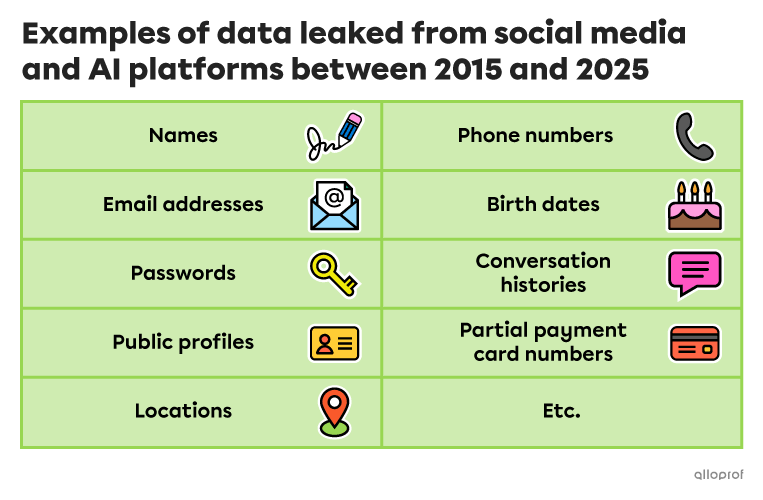
For more information on the platforms involved, see the references at the bottom of this page.
Once your personal data is in the hands of malicious individuals, it opens the door to privacy violations, which in many cases can damage your reputation, your finances, and your mental health.
Privacy violations can take many forms. Here are some examples.
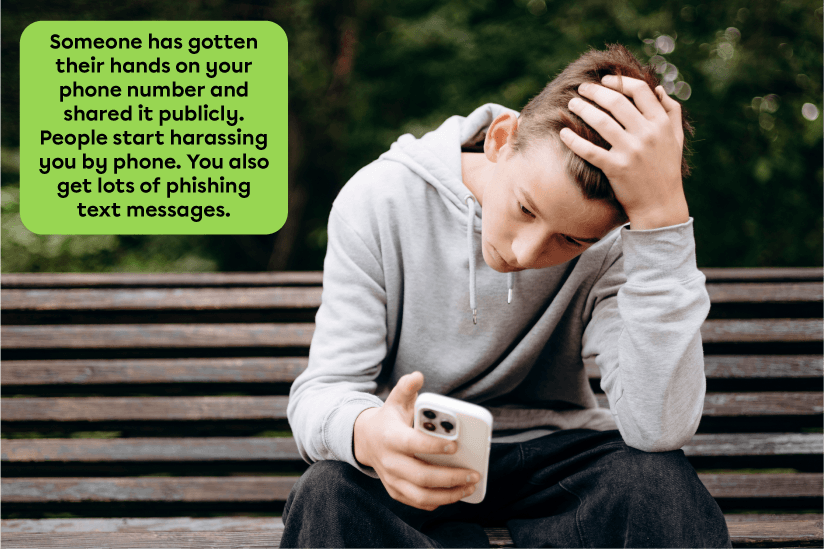
A malicious individual may reveal personal information in order to harm you. This is what we call doxing. This can easily lead to harassment.
A malicious individual can also blackmail you by threatening to reveal potentially compromising or intimate personal information (e.g., a private conversation or photos).
Here’s an example of blackmail leading to sextortion.
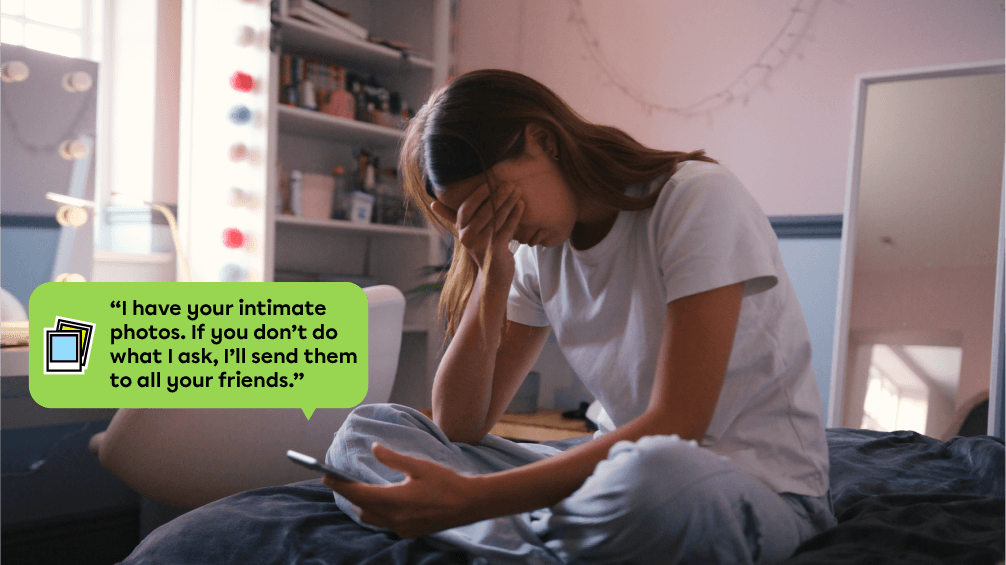
In Canada, the Canadian Centre for Child Protection receives an average of six sextortion alerts a day. Sextortion happens mostly on Instagram and Snapchat.[5]
To learn more about cyberbullying, sexting, and sextortion, consult the section Resources for You.
Have you ever gotten a text message telling you to click a link, or a message from someone you don’t know offering you a job?
These are phishing attempts. They happen because your phone number or other contact information has been made public. The goal of phishers is often to get information or money from you.
Here are some examples of phishing attempts where a malicious person is trying to get information or money by convincing you to click an unsecured link or by talking to you directly.
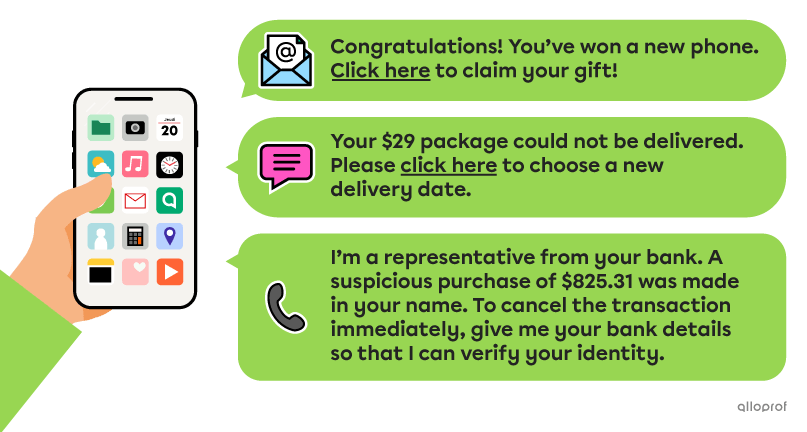
If you receive a phishing email or text message, remember: Never click any links in the message. If you receive a suspicious call, it’s best to just hang up. You can also call your bank yourself to see if the information the potential phisher gave you is true.
A survey conducted by Equifax Canada in 2025 found that one in three Canadians had been targeted by phishing attempts via scam texts[6]. Moreover, between 2022 and 2025, “the Canadian Anti-Fraud Centre (CAFC) [. . .] received nearly 24 000 phishing reports.”[7]
To learn more about phishing, consult the section Resources for You.
If your personal data—and especially your sensitive data—is out in the open, others may use it to make judgments about you and make unfair or even discriminatory decisions as a result. Even though such practices are illegal, these types of judgments can still cost you opportunities.
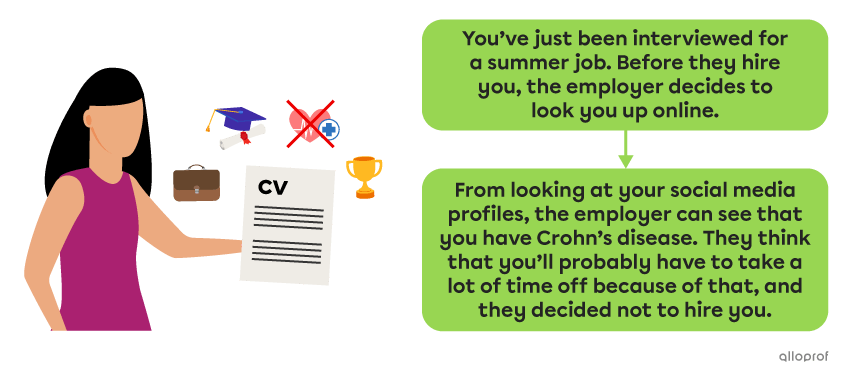
According to a study conducted in 2023, 65% of Canadian companies surveyed say they review candidates’ social media before hiring them (Harris Poll, 2023)[8]. Among these companies, 41% found content that dissuaded them from hiring a candidate.
With data such as your full name, birth date, address, social insurance number, and so on, a malicious individual can impersonate you. This is called identity theft.
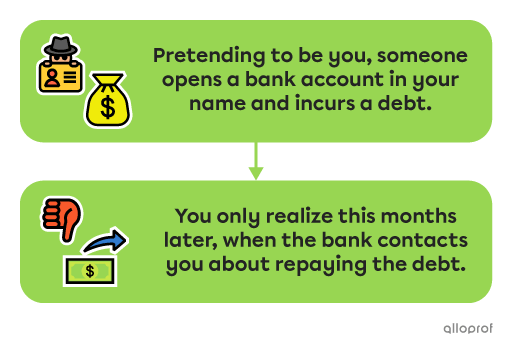
In Canada, the number of identity theft cases associated with cybercrime rose by around 29% between 2020 and 2024 (Statistics Canada, 2024)[9]. These are only the cases reported by the police stations surveyed.
To learn about identity theft, consult the section Resources for You.
If your financial data (bank details, payment card number, etc.) is revealed, a malicious individual could gain access to your accounts. You could be the victim of direct financial fraud.
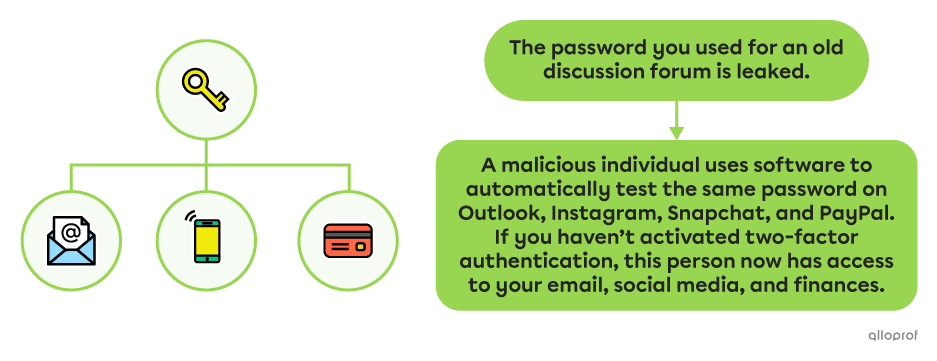
To learn more about financial fraud, consult the section Resources for You.
Many people use the same password for multiple online platforms. When an account’s username and password are made public, a malicious person can use the opportunity to compromise other accounts with the same password.
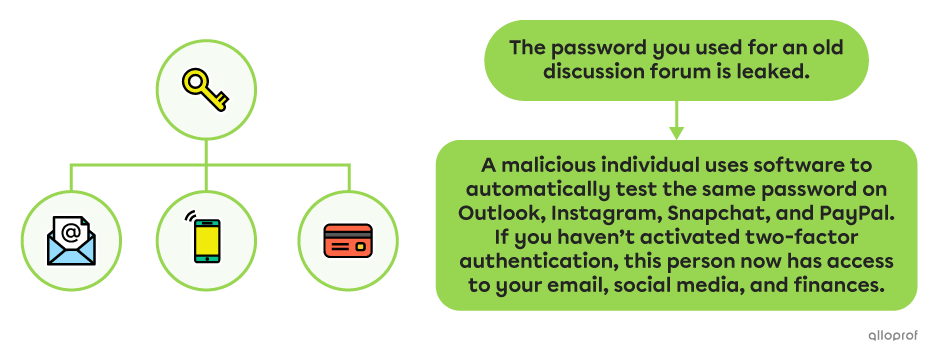
In 2024, a group of cybercriminals published a historic compilation of more than 10 billion stolen passwords![10]
“I’ve nothing to hide.” You’ve probably heard this phrase 100 times, and you may have even said it yourself. Personal data and online security may not seem like a big deal.
It can be hard to understand the risks. Why?
- Your data is digital, which can make it feel less real.
- Often, the risks are long-term, so it can make you think it is unlikely that something bad will happen.
- A data breach can happen months or even years after you’ve shared something.
- A malicious person might act years after a data breach so their victim will let their guard down.
- Your personal data may be stored for a very long time, so if you don’t delete it, that old data may be a point of vulnerability for a long time.
The rise of influencers and content creators has made it increasingly common to share a lot of information online without worrying about what’s personal or not. It can be hard to resist the temptation to share things when acting on impulse feels so much more satisfying in the moment. Remember that the goal isn’t to stop sharing altogether, but learning to share differently.
In the next section, we’ll give you the tools you need to protect your data!
When what you share falls into the hands of the wrong people, everything can go wrong, and what started as something fun or convenient can get out of control.
First, assume that everything on the internet is forever and that everyone will be able to see it one day or another. That goes for AI, social media, your phone’s apps and the internet in general.
Your data belong to you: Protect them!
Remember that the goal isn’t to stop sharing things online, but to rethink the way you share.
We share tips to help you develop good online privacy habits.
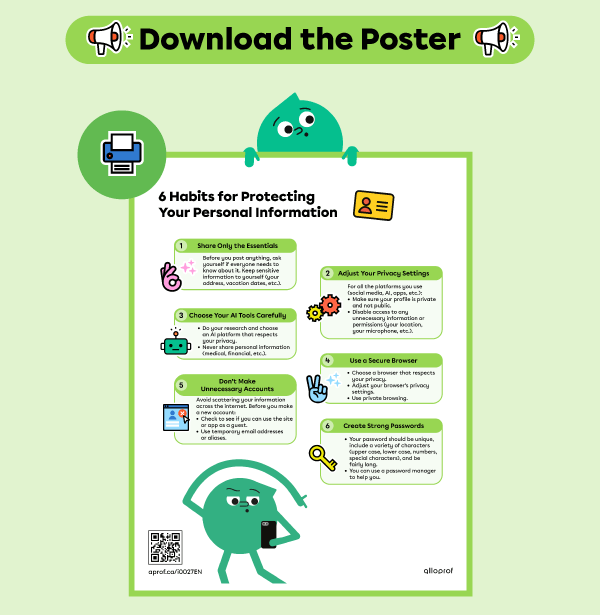
Your digital identity is constructed from your photos, comments, conversations, browsing history, and so on.
Ask yourself questions like:
- Does Twitch need to have my full name, or can I use a username?
- Does Instagram need to have my birth date?
- Do I need to share the name of my school on Snapchat?
Protect your digital identity. Avoid posting embarrassing photos and always be respectful in your interactions and comments. Once you’ve posted something, anyone can share it and it’s out of your control.
What You Can Do Right Now
You can go into any account you have and:
- Delete unnecessary information from your profile
- Delete compromising photos and comments
On social media, AI platforms, your phone’s apps, and your online accounts in general, access your settings.
- Take the time to disable access to any unnecessary information or permissions (your location, your microphone, etc.).
- Make sure your profile is private and not public. That way, only people you know (like family and friends) will be able to see your profile. Don’t let strangers snoop around in your life.
What You Can Do Right Now
- Start by changing the settings for just one of your online profiles. This will give you the motivation boost you need to tackle the rest of your accounts afterward.
- Go through your contact list and remove people you don’t know at all or have never met in real life.
To find out how to access your settings, see the list of links below:
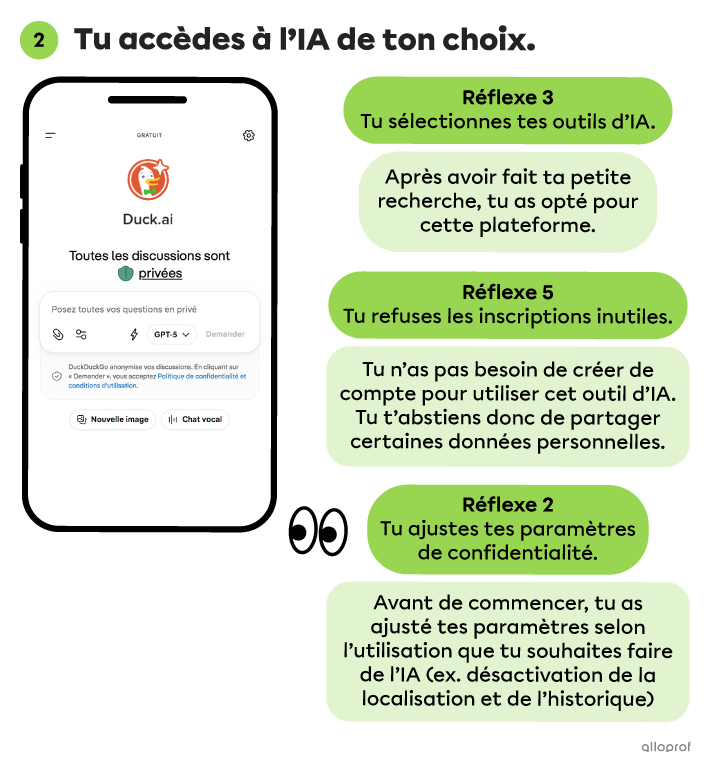
Not all AI platforms are created equal. Some chatbots harvest your data for training or sell your data, while others don’t.
Do your research. Using the AI recommended by your school board is a good start. When your school has an educational licence, your data is private, meaning it is neither used to train AI nor sold to third parties.
Be careful!
While conversations with AI may feel smooth and natural, don’t forget that AI is neither a friend nor a trusted adult. Be careful when chatting with AI and don’t share sensitive information.
What You Can Do Right Now
- Adjust your privacy settings.
- Find out what the AI platform does with your data. This information can be found in the platform’s terms of use (privacy policy).
When you browse the web, your browser may collect a certain amount of data.
Secure your browsing.
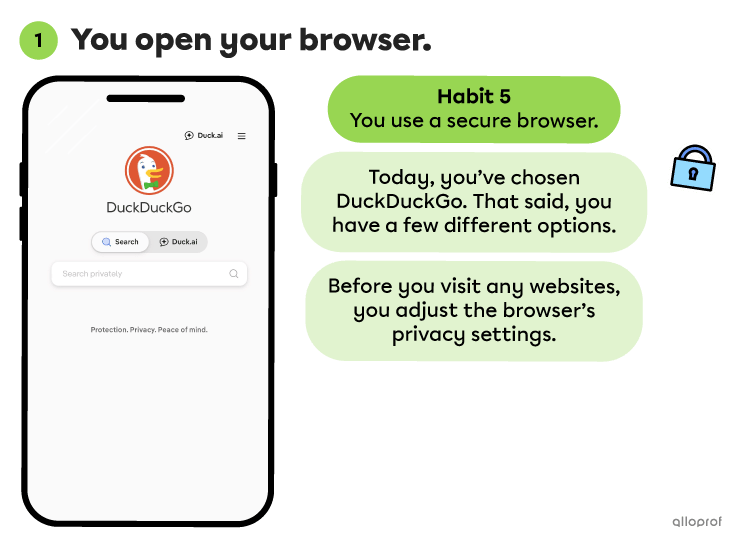
- As mentioned above, you can access your browser’s settings to restrict access to your data (location, history, cookies, etc.).
- You can use private browsing.
- If, despite everything, your browser is still too curious, choose another browser with a reputation for respecting privacy (like Firefox, Brave, or DuckDuckGo).
These days, it seems like you have to create an account for absolutely everything! Before you make a new account, ask yourself if you really need to.
Are you making a one-off purchase from an online store? Use the “Checkout as Guest” option instead of creating a full profile. Want to download a free document? Use a temporary email address or alias. This will prevent your information from being scattered across dozens of servers.
What You Can Do Right Now
- Delete old accounts you no longer use. Start small. Delete one account and you’ll feel motivated to delete more afterward.
- On your phone, tablet, or computer, delete applications you no longer use. They may still be collecting data in the background.
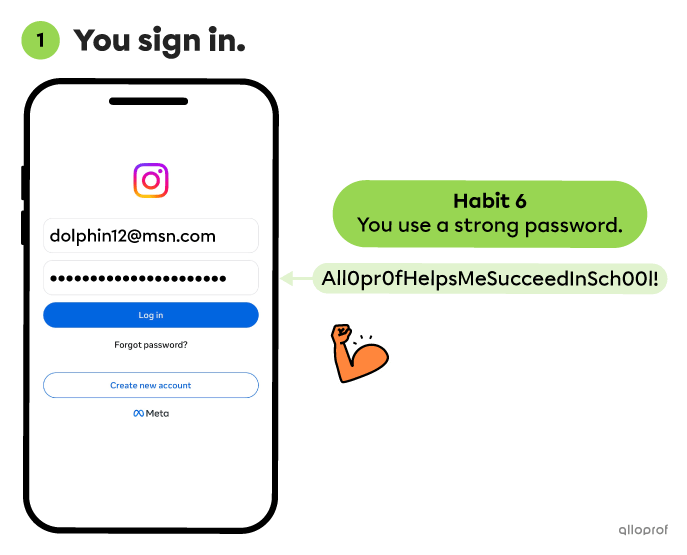
Ditch “123456” and your pet’s name for good. Your password should include a variety of characters (upper case, lower case, numbers, special characters) and be fairly long. You can use a password manager to help you.
And don’t forget to use a different password for every account. If the password for one of your accounts is compromised and your other accounts use the same password, then a malicious individual will have access to all of your accounts!
To learn more about secure passwords, consult the section Resources for You.
You’re thrilled to have passed your driver’s license exam, and you just received it in the mail. You want to share the news with your friends on Instagram. Here’s an example of how to do it the right way.


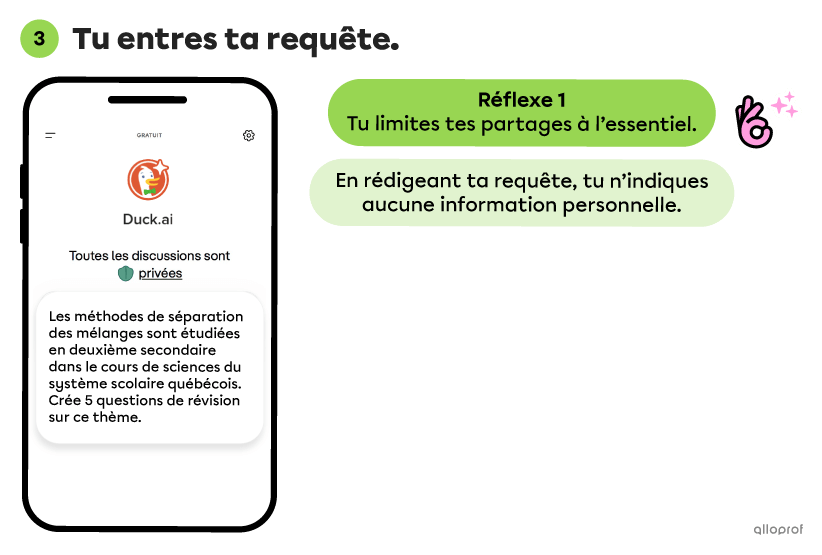
You’re at home, studying for an exam with the help of generative artificial intelligence (GenAI). Here’s how to apply your good privacy habits.
Alloprof is committed to the privacy and security of all its users. In all its interactions with your data, Alloprof complies with Bill 25, a law that came into effect in 2022 to protect the privacy of Quebecers.
To the extent possible, the data we collect on the site is anonymized and even encrypted when necessary.
Alloprof collects data when you browse its website. This includes when you:
- View content (concept sheets, videos, etc.)
- Create a user account
- Use the Help Zone
- Use the smart summary tool in the search bar
- Use the Ask a Teacher service
For example, when you create a user account, you share the following information with us:
- Your email
- Your grade level
- Your school’s province
- Your primary language of instruction
- Your IP address
This data cannot be easily used to personally identify you, since Alloprof does not ask for your name. Instead, you create a username like FantasticDolphin78!
Other data may also be collected. For more information, see Alloprof’s Privacy Policy and Terms of Use.
The data collected is used for several purposes, including improving the services offered by Alloprof, personalizing the user experience, and guaranteeing the security of interactions on the platform. For more information, click here.
Examples:
- Do you frequently view math concept sheets from your account? Alloprof can use your history to suggest other relevant concept sheets on the same subject.
- Is a phone service user harassing an Alloprof teacher? It’s rare, but it has happened. We can then use the user’s phone number to block them. Only the Alloprof department responsible for blocking said phone number will have access to this personal information. This data is encrypted for other departments.
Your data belongs to you! At any time, you can exercise your rights and withdraw your consent to the collection, storage, and processing of your data.
You can also submit a request to delete your personal data.
The privacy of our users is a priority. Although you can never be 100% safe from a data breach, Alloprof does its utmost to minimize the risk of breaches.
At Alloprof, all departments have different needs in terms of data analysis. Each department only has access to the minimum amount of information required to do its work. For example, one Alloprof department might know that the user FantasticDolphin78 logs in on a mobile device, while another department might not know which device they use.
In addition, the data collected is anonymized as far as possible and encrypted where necessary.
All Alloprof employees also receive ongoing cybersecurity training to significantly reduce the risk of data breaches due to human error.
Commission d’accès à l’information du Québec (CAI). (2025). Rappel annuel d’activités et de gestion 2024-2025. https://www.cai.gouv.qc.ca/uploads/pdfs/CAI_RAAG-2024-2025.pdf
Verizon Business. (2025). 2025 Verizon Data Breach Investigations Report. https://www.verizon.com/business/resources/reports/dbir/
Examples of social media platforms that have suffered data breaches:
Privacy Rights Clearinghouse. (2026). Data Breaches Chronology.
https://privacyrights.org/data-breaches
Information is beautiful. (2025). World’s Biggets Data Breaches and Hacks.
https://informationisbeautiful.net/visualizations/worlds-biggest-data-breaches-hacks/
Wikipedia. (2026). List of data breaches.
https://en.wikipedia.org/wiki/List_of_data_breaches
Upgard. (2025). The 83 Biggest Data Breaches of All Time.
https://www.upguard.com/blog/biggest-data-breaches
Examples of AI platforms that have suffered data breaches:
Independent. (2025). ChatGPT user’s personal details exposed in data breach, OpenAI reveals.
https://www.independent.co.uk/tech/chatgpt-data-breach-openai-hack-b2874393.html
Bitdefender. (2024). Unknown People Fraudulently Accessed Spaces from AI Company ‘Hugging Face’.
https://www.bitdefender.com/en-gb/blog/hotforsecurity/unknown-people-fraudulently-accessed-spaces-from-ai-company-hugging-face
Cloaked. (2026). Were Your Secrets at Risk in the Google AI Data Breach? Here’s What You Need to Know.
https://www.cloaked.com/post/were-your-secrets-at-risk-in-the-google-ai-data-breach-heres-what-you-need-to-know
Canadian Centre for Child Protection. (2026). Online Harms: Sextortion. Cybertip, Canada’s national tipline for reporting the online sexual exploitation of children.
https://www.cyberaide.ca/fr/dangers-internet/sextorsion/?utm_campaign=sl&utm_term=/app/fr/internet_safety-sextortionEquifax Canada. (2025). One in Three Canadians Targeted by Scam Texts in Just Three Months, Equifax Canada Survey Finds.
https://www.equifax.ca/about-equifax/newsroom/-/intlpress/one-in-three-canadians-targeted-by-scam-texts-in-just-three-months-equifax-canada-survey-findsGovernment of Canada. (2025). Don’t get hooked: understanding phishing and how to stay safe.
https://www.getcybersafe.gc.ca/en/blogs/dont-get-hooked-understanding-phishing-stay-safeExpress Employment Professionals. (2023). Data-Driven Workforce Trends for 2023. Harris Poll 2023. https://www.expresspros.com/jobinsights-canada
Cited by CIC News. (2023). Canadian employers are using social media to screen job candidates. https://www.cicnews.com/2023/04/canadian-employers-are-using-social-media-to-screen-job-candidates-0434137.html
Statistics Canada. (2025). Police-reported cybercrime, by cyber-related violation, Canada (selected police services).
https://www150.statcan.gc.ca/t1/tbl1/fr/cv.action?pid=3510000101&request_locale=en- Security Daily Review. (2024). The RockYou2024 Security Breach: 10 Billion Credentials Compromised. https://dailysecurityreview.com/security-spotlight/the-rockyou2024-security-breach-10-billion-credentials-compromised/