Our use of electronic devices and digital services has an impact on the environment. We’ve got some tips to help you reduce your ecological footprint.
The ecological impact of an action or object can be measured using various indicators. For example, ecological impact can be assessed using carbon footprint and ecological footprint.
Carbon footprint refers to the amount of greenhouse gas (GHG), primarily carbon dioxide (CO₂), that is produced by human activities such as:
- Housing and energy (heating, lighting, etc.)
- Food (agriculture, livestock farming, etc.)
- Transportation
- The consumption of goods and services (manufacturing devices, surfing the Web, buying clothes, etc.).
Ecological footprint is an estimate of the land (or aquatic) area required by an individual:
- To ensure they have all the resources to meet their needs
- To ensure the disposal of their waste
Digital pollution mainly comes from the manufacturing of electronic devices, such as cell phones and computers, followed by their use.
In 2022, the scale of digital pollution was such that the digital industry was producing almost two times more greenhouse gas (GHG) as the aviation industry.[1]
To understand the impact of our digital consumption, it’s important to consider the entire life cycle of electronic devices, from the extraction of raw materials to the product’s end of life.
When we assess the impact of a product from the time it’s manufactured to its end of life, it’s called a Life-Cycle Analysis (LCA).
Pour comprendre l’impact de notre consommation numérique, il est important de considérer le cycle de vie des appareils électroniques au complet, de l’extraction des matières premières jusqu’à la fin de vie.
To help you better understand the pollution caused by digital technology, here’s a three-step breakdown of the environmental impact of a smartphone’s life cycle[2]:
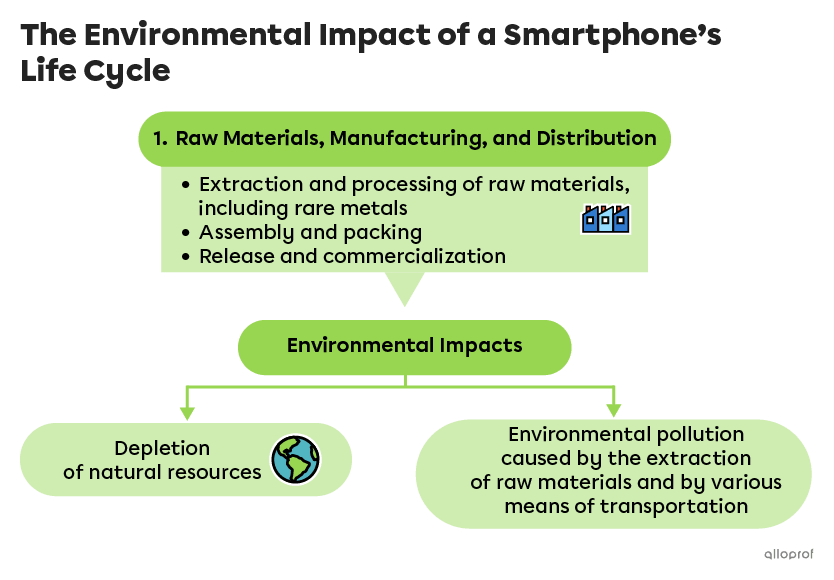
This stage is the most polluting. It corresponds to around 80% of the CO2 emissions[3] produced during the life of a smartphone.
To manufacture one cell phone, more than 70 kg of raw materials may need to be extracted, in addition to requiring 76,010 L of water.[4]
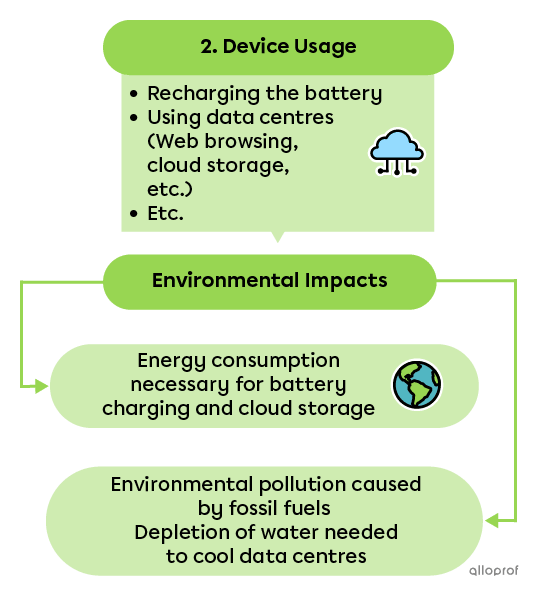
Device usage has a significant ecological impact, since the data centres operate 24 hours a day to host and process searches, attachments, and videos.
Often, data centres are located in countries that use fossil fuel energy sources, which are highly polluting[2].
What’s more, data centres don’t just consume electricity: They generate so much heat that millions of litres of water are needed to cool them down.
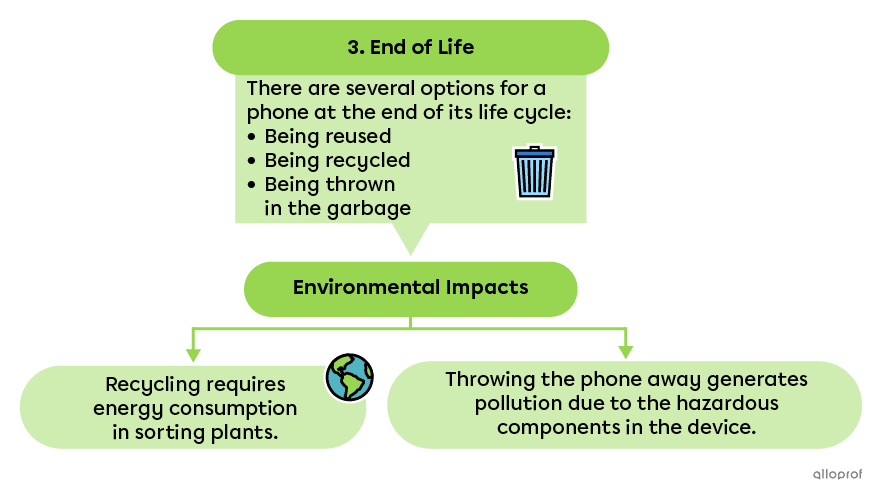
The ecological impact of an end-of-life device will depend on what you choose to do with it when you want to get rid of it. For example:
- Recycling involves energy consumption.
- Throwing the phone in the garbage (which 90% of Canadians do) generates pollution due to the phone’s hazardous components. For example, lithium batteries contaminate the soil and the environment.
- However, reusing the phone has no harmful ecological impact. Plus, these devices contain valuable materials (copper, gold, silver) that can be recycled.
Generative artificial intelligence (GenAI) helps you do tons of tasks, but behind the scenes, it requires an enormous amount of electricity to operate. Every time you use GenAI to ask a question or generate an image, it uses energy from a data centre somewhere in the world.
Are Data Centres a Problem for the Planet?
A data centre is a huge building filled with thousands of high-powered computers known as servers. Data centres also contain networking equipment and other storage systems.
Data centres operate 24 hours a day to store all our emails, photos, and videos online, and to process our artificial intelligence queries and web searches. Since they need a constant energy source, they are often powered by natural gas or coal, which makes them highly polluting. Plus, they need a lot of water (around 1,363,827 litres per day[5]) to cool their servers.
In 2022, a single supplier’s data centres used more than 21 million cubic metres of water[6]. That’s the equivalent of filling more than 8,400 two-metre-deep Olympic-size swimming pools to the brim!
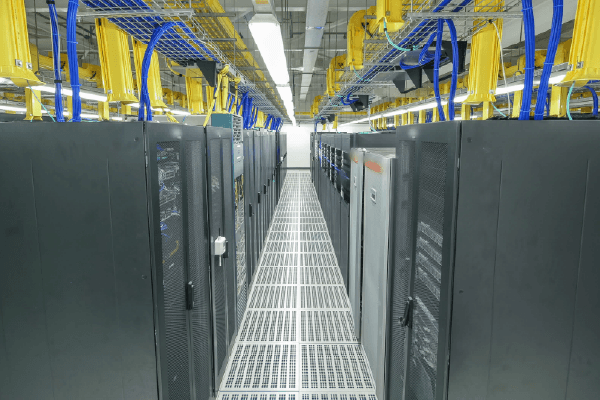
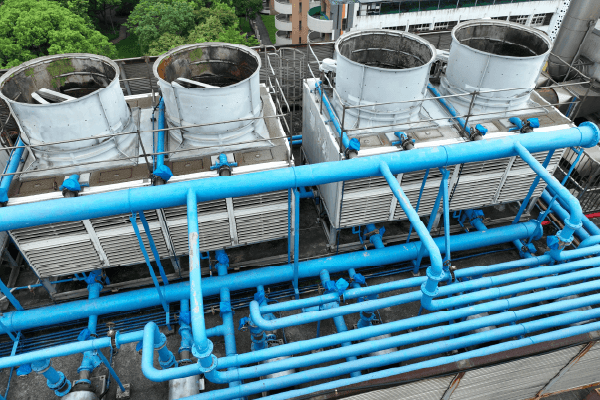
Did you know that green initiatives involving data centres are starting to be rolled out? Some data centres are recovering the heat generated by the servers to heat buildings.
The Environmental Impact of Generative AI
The exact amount of energy consumed by artificial intelligence models (ChatGPT, Gemini, etc.) is often not disclosed. So we don’t know exactly how polluting AI is. However, we know that the data centres running the AI are operating 24 hours a day. Since they need a constant energy source, they are often powered by natural gas or coal, which makes them highly polluting.
It is estimated that global AI usage could soon consume more electricity than the whole of Japan.[7]
Asking AI a question requires around 10 times more energy[8] than a simple search on a conventional search engine. Here are a few examples of the environmental impact of our generative AI use:
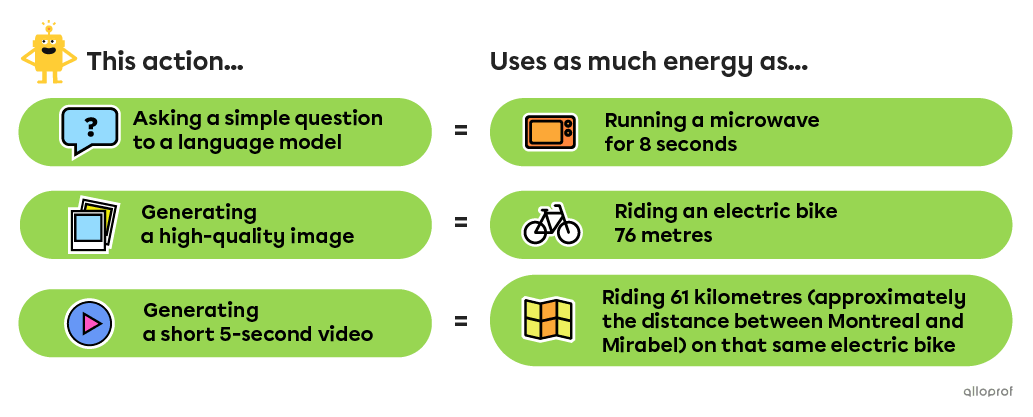
These actions—multiplied by millions of users every single day—are exploding the demand for electrical energy. That’s why it’s important to use GenAI in moderation. Also, when you give AI an instruction, make sure it’s complete and well written, because asking a vague question that requires several exchanges and corrections consumes more energy.[9]
Please note: Practicing digital sobriety does not mean you have to stop using digital tools entirely. The key is to use them with good judgment and to question the relevance of their use.
For example, using GenAI to help you understand a difficult concept or to generate a quiz to study before an exam is a smart use of it. On the other hand, using GenAI to create funny images or unnecessary videos is less so.
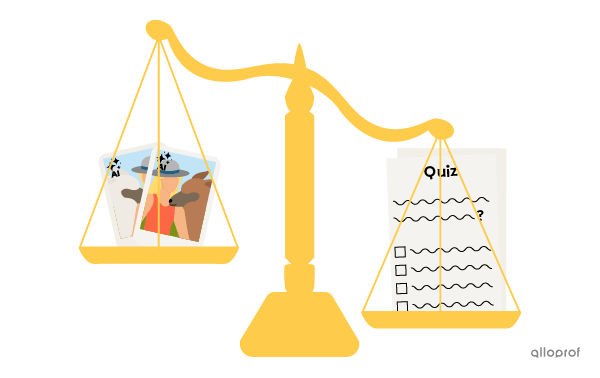
An example of digital sobriety is using GenAI to help you understand a difficult concept instead of using it to create funny images.
To find out how Alloprof applies its digital sobriety principles to its products, you can check out this page Artificial Intelligence and Alloprof
This table can help you compare the energy usage of some of your daily digital activities.[10, 11]
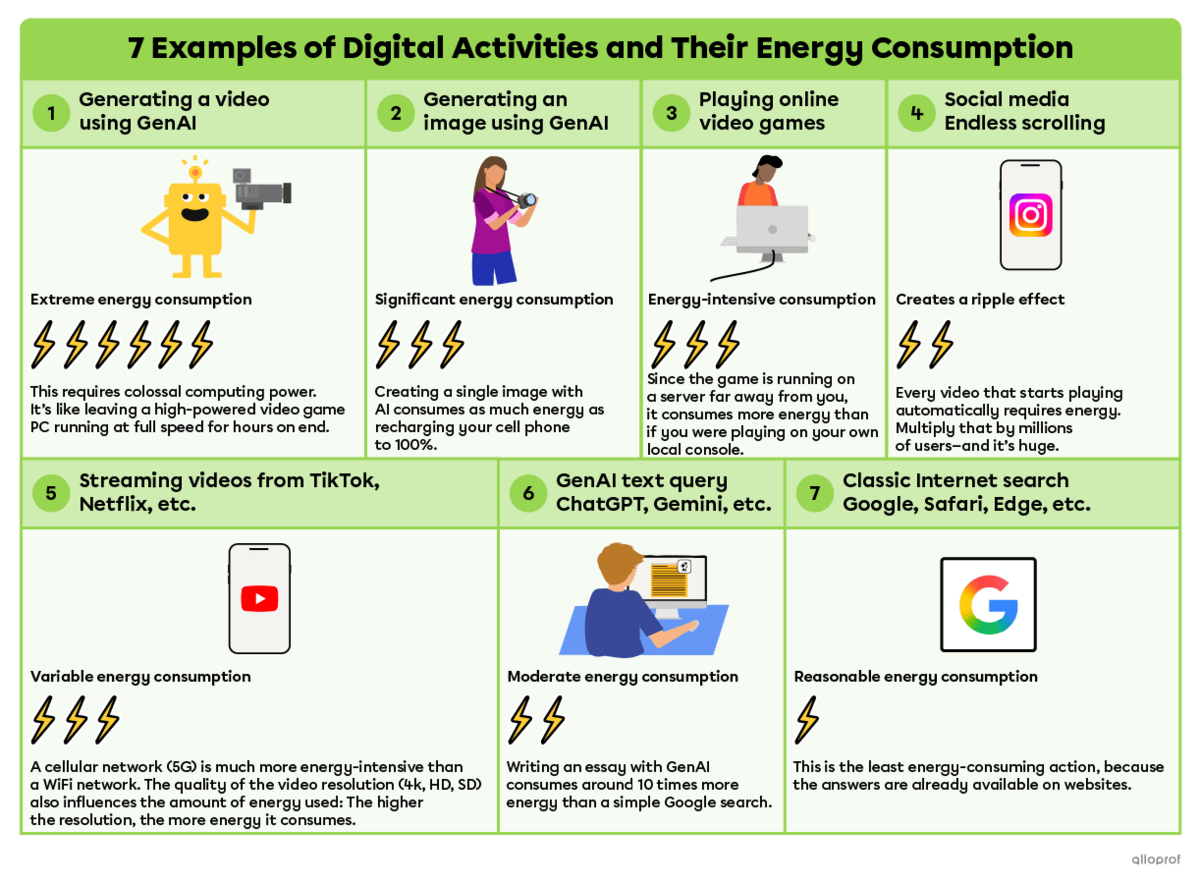
You can reduce your digital pollution by adopting environmentally responsible digital habits. This is called digital sobriety.
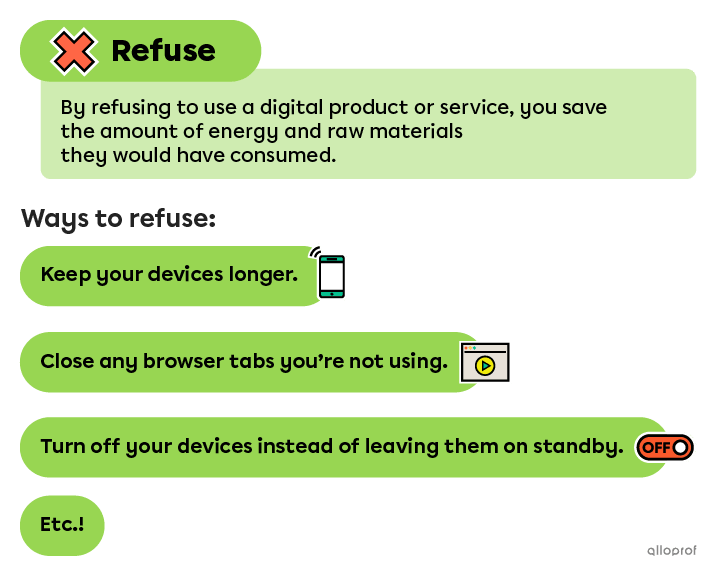
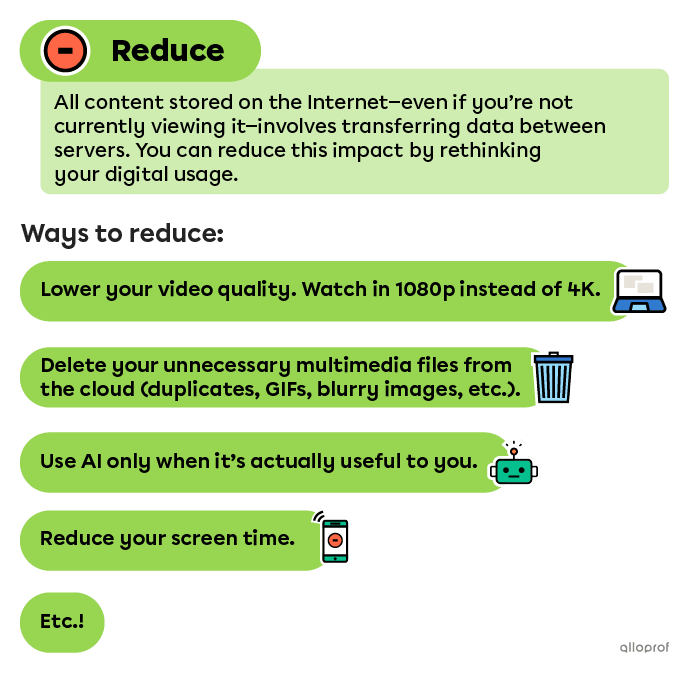
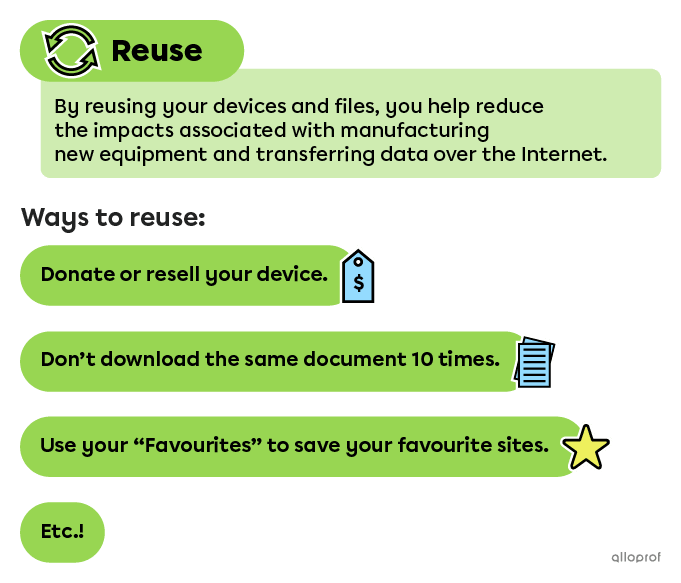
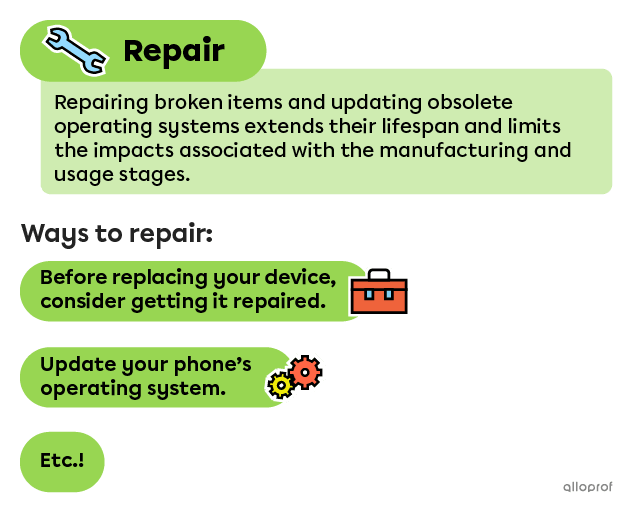
To practise digital sobriety, you can use the 5Rs strategy: Refuse, Reduce, Reuse, Repair, and Recycle.
Refuse
Reduce
Reuse
Repair
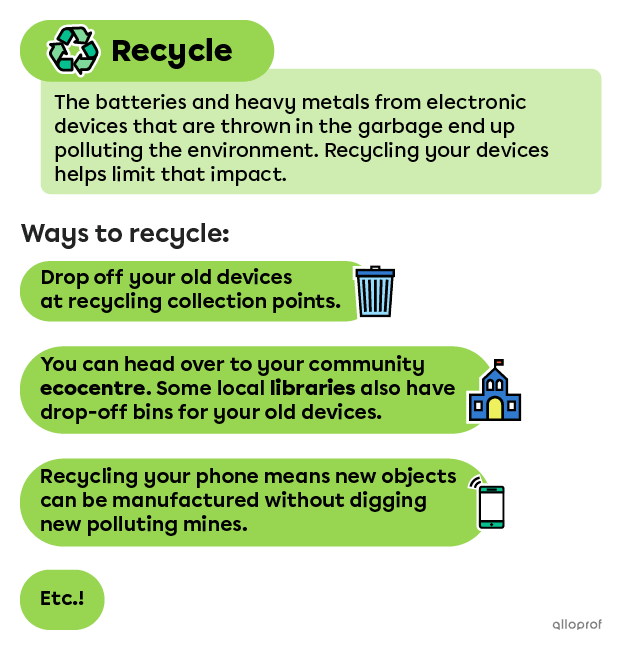
Recycle

You can also download a printable image of these tips!
Jordan, P. "Deux fois plus polluant que l’aviation, le numérique pèse insidieusement sur le climat." RTS. May 24, 2022.[URL]
Ville de Montréal, Sud-Ouest borough (s.d.). La pollution numérique. n.d. [URL]
Planète Énergies. “Life Cycle Assessment (LCA) of a Smartphone.” 2025. (URL)
République française. "Combien de matières premières pour satisfaire la consommation des Français?" May 28, 2025. (URL)
Smith, A. "Data’s dark, thirsty side." ABC National. April 22, 2025. (URL)
Towler, L. "The hidden environmental cost of digital: Insights from UNCTAD’s 2024 report." July 16, 2025. (URL)
Le Journal de Montréal. "L’IA consommera autant d’électricité qu’un pays entier." June 7, 2025. (URL)
O’Donnell, J. et Crownhart, C. "We did the math on AI’s energy footprint. Here’s the story you haven’t heard." MIT Technology Review. 2025 (URL)
Google. Google 2025 Environmental Report. 2025. (URL)
République française, Réseau Canopé. Les IA génératives en éducation. Repères, ressources et activités pour la classe. 2026. (URL)
Vahdat, A. et Dean, J. (2025). "How much energy does Google’s AI use? We did the math." (URL)