Here are two ways to find the inverse of a logarithmic function:
To determine the inverse of a logarithmic function graphically, you can proceed as follows:
Graph the inverse of the following logarithmic function.||
y=-3\log_5(2(x+4))+3.||
- Graph the function using points.
Since there are no given points or table of values, we must use the rule and substitute |x| with any value.
If |x = -3.9|, we get:||
\begin{align}f(-3.9)&=-3\log_5\left(2(-3.9+4\right))+3\\
&=-3\log_5\left(2\times0.1\right)+3\\
&=-3\log_5\left(0.2\right)+3\\
&=-3\times-1+3\\
&=3+3\\
&=6\end{align}||
The graph of the logarithmic function therefore passes through the point |(-3.9, 6).| We repeat this for other values of |x| to find other points.
x | y |
|---|---|
|-3.9| | |6| |
|-3.5| | |3| |
|-1.5| | |0| |
|8.5| | |-3| |
We connect the points to draw the curve on the graph.
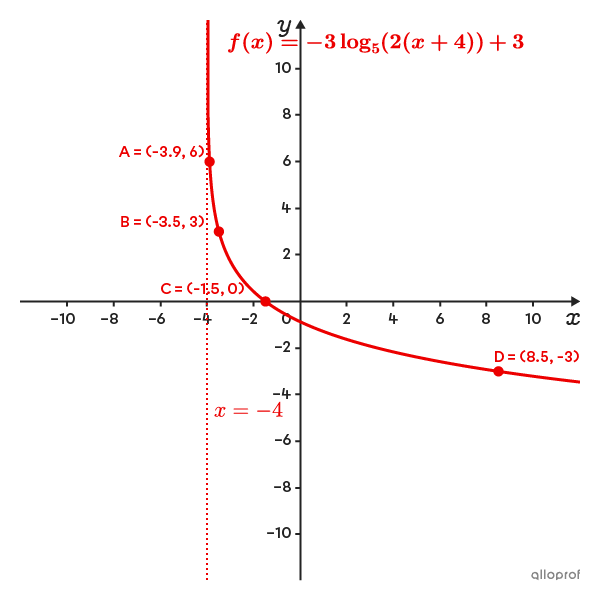
- Draw the line of reflection |\boldsymbol{y = x}.|
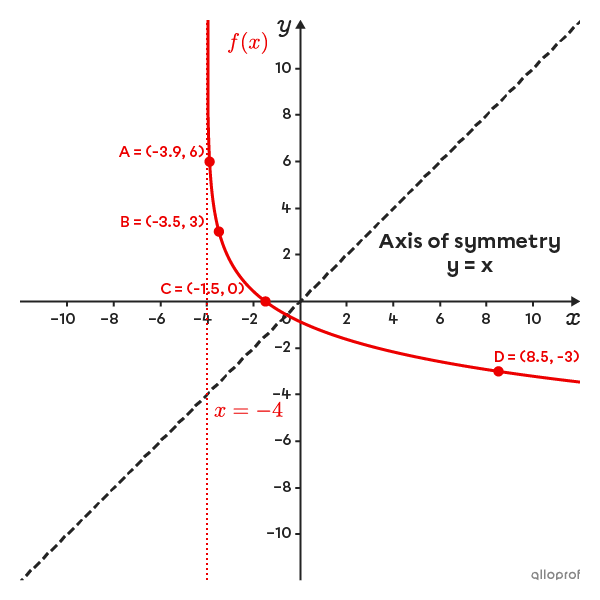
- Reflect the function across the line |\boldsymbol{y=x}|.
We interchange the |x| and |y| coordinates of the points, then plot them on the graph.
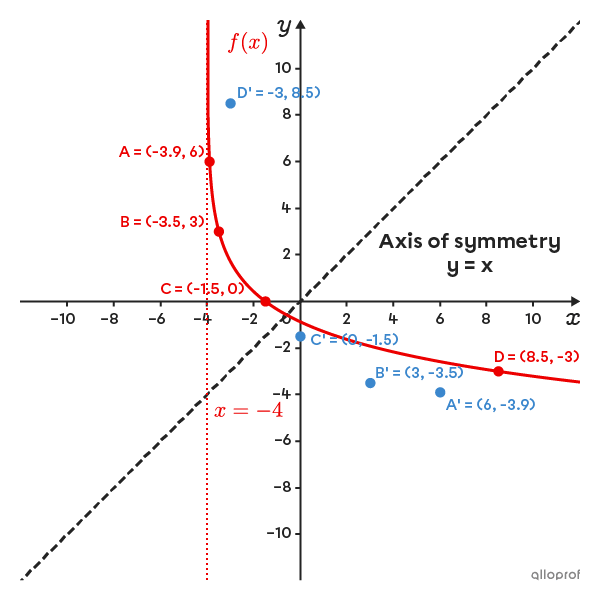
- Graph the function
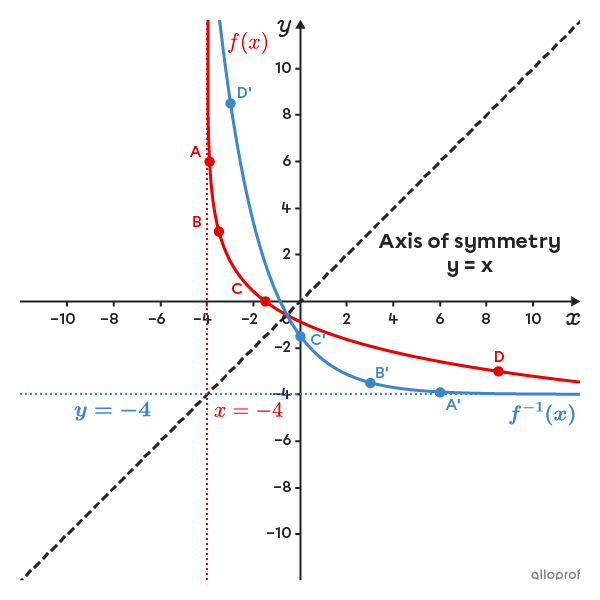
Therefore we get the inverse of the initial logarithmic function. We can use the points of the inverse to find the rule of this exponential function.
A logarithmic function and its inverse always have the same variation.
- If the logarithmic function is increasing, its inverse is increasing.
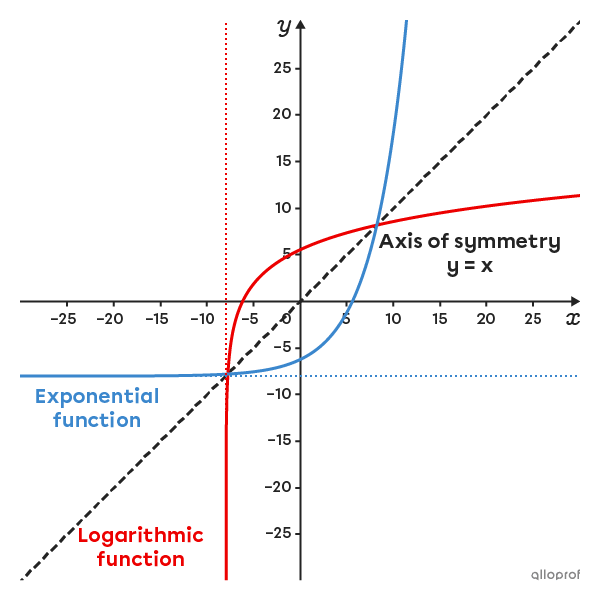
- If the logarithmic function is decreasing, its inverse is decreasing.
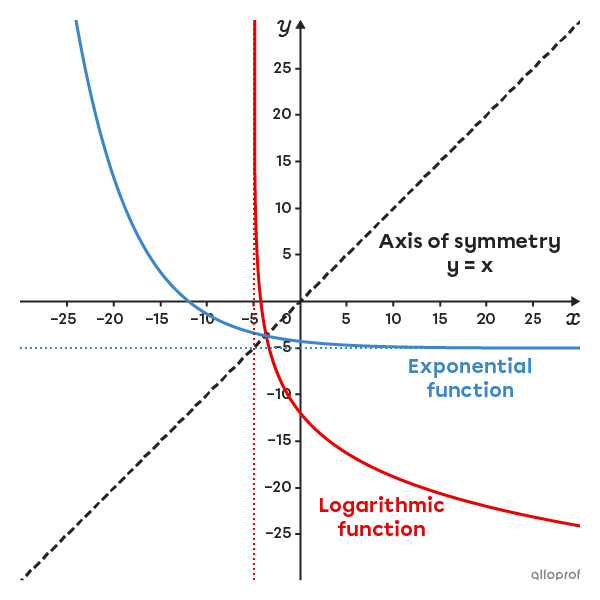
To determine the inverse of a logarithmic function algebraically, you can proceed as follows:
- Interchange the variables |x| and |y| in the initial rule.
- Isolate the expression containing the logarithm.
- Isolate |y| by converting to exponential form.
Determine algebraically the rule of the inverse of the following logarithmic function.||f(x)=-4\log_7\left(3(x-6)\right)+8||
- Interchange the variables |\boldsymbol{x}| and |\boldsymbol{y}| in the initial rule.
||\begin{gather}\boldsymbol{\color{#C58AE1}y}=-4\log_7\left(3(\boldsymbol{\color{#560FA5}x}-6)\right)+8
\\\Downarrow\\
\boldsymbol{\color{#560FA5}x}=-4\log_7\left(3(\boldsymbol{\color{#C58AE1}y}-6)\right)+8\end{gather}||
- Isolate the expression containing the logarithm.
||\begin{align}x&=-4\log_7\left(3(y-6)\right)+8\\
x-8 &= -4\log_7\left(3(y-6)\right)\\
-\dfrac{1}{4}(x-8) &= \log_7\left(3(y-6)\right)\end{align}||
- Convert to exponential form to isolate |\boldsymbol{y}.|
||\begin{align}7^{\frac{-1}{4}(x\,-\,8)} &= 3(y-6)\\ \dfrac{7^{\frac{-1}{4}(x\,-\,8)}}{3} &= y-6\\ \dfrac{7^{\frac{-1}{4}(x\,-\,8)}}{3}+6 &= y\\
\dfrac{1}{3}(7)^{\frac{-1}{4}(x\,-\,8)}+6 &= y\end{align}||
Therefore, the rule of the inverse is |f^{-1}(x)=\dfrac{1}{3}(7)^{\frac{-1}{4}(x\,-\,8)}+6.|
If we carefully observe the initial function |\left(f(x)\right)| and its inverse |\left(f^{-1}(x)\right),| this is what we notice:
- The base |\boldsymbol{\color{#FF55C3}{c}}| of the inverse is the same as that of the initial function.
- The inverse of parameter |\boldsymbol{\color{#3A9A38}{a}}| of the initial function corresponds to parameter |\boldsymbol{\color{#EC0000}{b}}| of the inverse.
- The inverse of parameter |\boldsymbol{\color{#EC0000}{b}}| of the initial function corresponds to parameter |\boldsymbol{\color{#3A9A38}{a}}| of the inverse.
- Parameter |\boldsymbol{\color{#3B87CD}{h}}| corresponds to parameter |\boldsymbol{\color{#FA7921}{k}}| of the inverse.
- Parameter |\boldsymbol{\color{#FA7921}{k}}| corresponds to parameter |\boldsymbol{\color{#3B87CD}{h}}| of the inverse.
||\begin{gather}f(x)=\boldsymbol{\color{#3A9A38}{a}}\log_\boldsymbol{\color{#FF55C3}{c}}\left(\boldsymbol{\color{#EC0000}{b}}(x-\boldsymbol{\color{#3B87CD}{h}})\right)+\boldsymbol{\color{#FA7921}{k}}\\\Updownarrow\\f^{-1}(x)=\boldsymbol{\color{#3A9A38}{\dfrac{1}{b}}}(\boldsymbol{\color{#FF55C3}{c}})^{\boldsymbol{\color{#EC0000}{\frac{1}{a}}}(x\,-\,\boldsymbol{\color{#3B87CD}{k}})}+\boldsymbol{\color{#FA7921}{h}}\end{gather}||
Find the rule of the inverse of the following logarithmic function:||f(x)=0.25\log_{10}\left(-\dfrac{2}{7}(x+9)\right)-6||
We can directly find the inverse as follows.||\begin{gather}f(x)=\boldsymbol{\color{#3A9A38}{0.25}}\log_\boldsymbol{\color{#FF55C3}{10}} \left(\boldsymbol{\color{#EC0000}{-\dfrac{2}{7}}}(x-\boldsymbol{\color{#3B87CD}{-9}})\right)+\boldsymbol{\color{#FA7921}{-6}}\\[3pt]
\Updownarrow \\[3pt]
\begin{aligned}f^{-1}(x)&=\boldsymbol{\color{#3A9A38}{\dfrac{1}{-\frac{2}{7}}}}(\boldsymbol{\color{#FF55C3}{10}})^{\boldsymbol{\color{#EC0000}{\frac{1}{0.25}}}(x\,-\,\boldsymbol{\color{#3B87CD}{-6})}}+\boldsymbol{\color{#FA7921}{-9}}
\\[5pt] &=-\dfrac{7}{2}(10)^{4(x\,+\,6)}-9\end{aligned}\end{gather}||