The atom is a particle of matter invisible to the naked eye. It is the basic unit of the molecule.
Since the atom is invisible to the naked eye, it took a long time to prove its existence and determine its properties.
The oldest recorded reference to the atom is attributed to the Indian philosopher Kanada around 600 BC. He hypothesized the existence of indivisible particles called anu. Around 400 BC, the Greek philosopher Democritus also spoke of indivisible particles which he called atomos.
In the 18th century, the English chemist John Dalton developed a model of the atom based on experimental data. It is known as Dalton's atomic model. Although this model contains some errors, it helped in understanding many things about the properties of the atom and about chemical reactions.
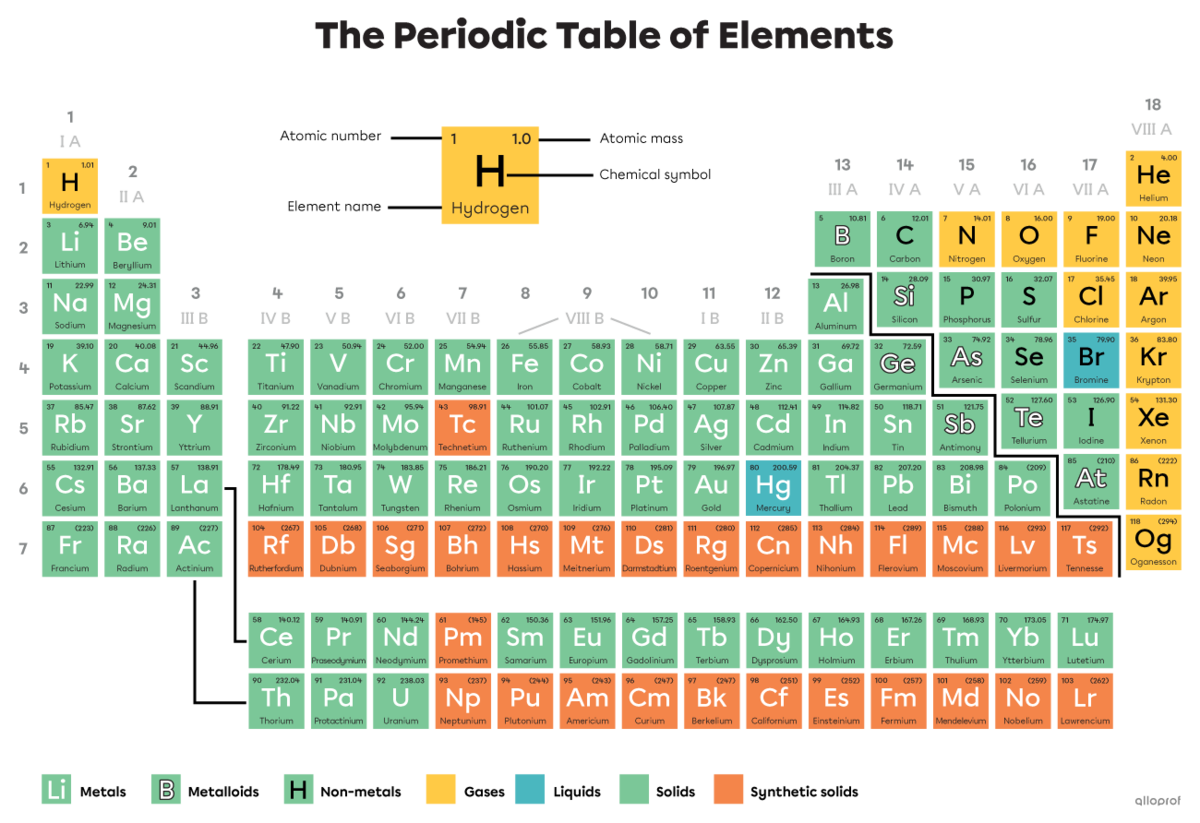
Today, 118 types of atoms are known. They are categorized in a table called the periodic table of elements.
Contrary to what John Dalton thought in the early 19th century, the atom is divisible. It consists of subatomic particles: protons, electrons and neutrons. The number of each subatomic particle varies according to the type of atom.
As the structure of the atom was gradually discovered, several atomic models were developed in the 20th century. Here are some examples.
Other models developed later showed that protons and neutrons are also divisible, and include even smaller particles.
Pour valider ta compréhension à propos de l’organisation de la matière de façon interactive, consulte la MiniRécup suivante.
